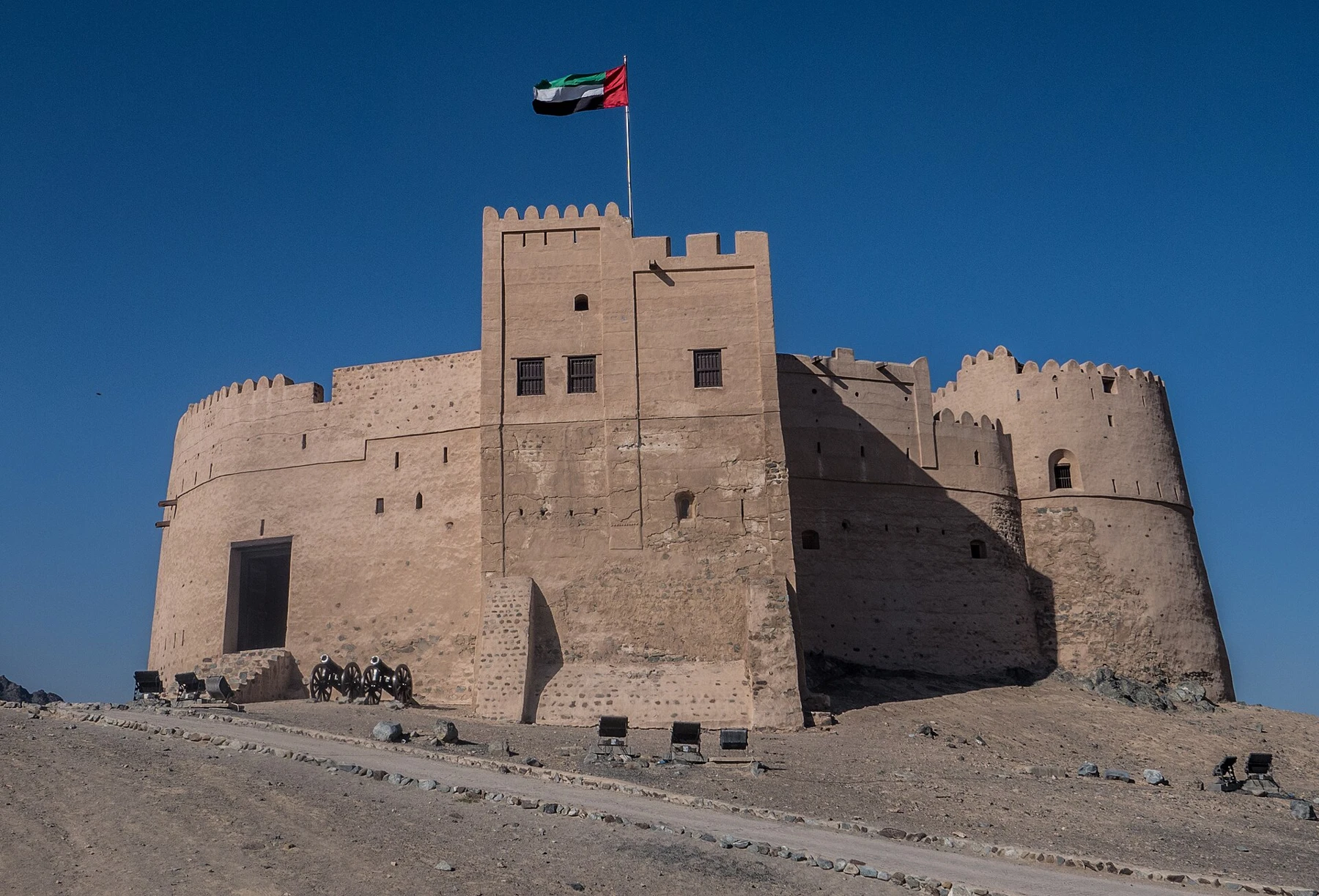
Fujairah Fort is a useful place to begin an east-coast visit because it makes geography visible. A visitor can look at a defensive structure, the surrounding settlement and the wider mountain-and-coast setting without reducing the emirate to a beach stop. The nearby museum adds a different kind of evidence: objects and interpretation that can help explain how people lived, worked and moved through this environment. The strongest visit connects those two forms of knowledge while preserving the distinction between what a building shows, what an institution explains and what the visitor infers.
This guide is an editorial framework for planning and understanding a heritage visit. It is not a live opening-hours or ticketing service. Confirm current access, tours, photography rules and accessibility with the official destination or institution. The practical suggestions below are intended to make the visit more meaningful, especially for residents introducing guests to Fujairah or families looking for an educational day beyond a familiar urban itinerary.
Begin with a place, rather than a superlative
Discover Fujairah describes the fort in old Fujairah, on a rocky hill near historic buildings and palm plantations. Its official destination material also pairs the fort with the museum as a family heritage visit. [1][2] Those descriptions provide a geographical starting point; they do not require the visitor to compete over which fort is oldest, largest or most important. A more useful question is what this particular place helps explain about this particular emirate.
Before going, locate the fort and museum separately and ask about the available route between them. A page describing a combined experience should not be treated as a promise that every visitor can enter every building at any time. Current arrangements may depend on opening schedules, conservation needs or programming. Establish the practical facts first. That allows the group to focus on the historical questions during the visit rather than spend its attention resolving transport, entry or timing problems at the last moment.
Understand the relationship between defence and settlement
A fort is often photographed as an isolated object. Its meaning becomes richer when the visitor asks what it relates to: an approach route, a settlement, cultivated land, a view or a place where authority was exercised. These questions invite observation without requiring the visitor to invent a military history for every wall. Notice the position of the building and then consult institutional interpretation about the purposes and periods associated with it.
Distinguish a reasonable question from an established answer. A narrow opening might invite a question about light, ventilation or defence; its exact historical function should not be assumed solely from appearance. The visitor's task is to look carefully and use the available evidence, not to fill every gap with a familiar story from another country. This approach is especially valuable in a family visit because it makes the process of learning visible. Adults can demonstrate that curiosity and accuracy belong together.
Treat restoration as part of the story
Historic buildings survive through maintenance, restoration and changes of use. A visitor should therefore ask which elements are original, which were restored and which belong to the site's modern presentation. An attractive finish does not make a building historically unimportant; an aged surface does not automatically establish authenticity. The relevant question is how the site has been preserved and how the institution explains that preservation.
When information is not available, leave the matter open. Avoid describing every visible component as belonging to one precise date. A useful notebook separates observed features from statements on labels and questions for a guide. That practice prevents an understandable enthusiasm for the site from becoming a confident but unsupported account. It also improves photographs taken for later writing: the image can be linked to a specific explanation rather than used as a generic symbol of the UAE's past.
Use the museum to ask different questions
A building encourages attention to space, movement and construction. A museum can draw attention to material, technique, chronology and social use. Move between these perspectives deliberately. After seeing the fort, ask what the museum can add about the people and activities associated with the wider region. Do not expect every object to have come from the fort itself unless the institution says so.
For each selected object, consider four questions. What is it made from? What evidence indicates its date or place? What activity might it have supported? What remains uncertain? These questions are more productive than trying to memorise a large number of labels. They also make it easier to compare objects without pretending that all of them belong to a single community or moment. Museums organise complex evidence for public understanding; the visitor can appreciate that work while still distinguishing a collection from a complete reconstruction of life.
Plan a focused visit for a mixed-age group
Families often try to make a cultural visit educational by adding more information. A better starting point is to reduce the number of questions and make participation possible for different ages. One person can look for materials, another for tools and another for signs of movement or exchange. A child who notices how a doorway or vessel was made has already found a meaningful route into the subject.
Set a small shared task: each participant chooses one feature or object and explains why it attracted attention. The explanation can be simple. It need not become a formal lesson or an examination. The purpose is to encourage careful looking and conversation. Build in time for questions and a break. A group that feels rushed will often remember the discomfort more clearly than the exhibits. A shorter visit with sustained attention can be more valuable than an ambitious schedule that requires everyone to keep moving.
A practical sequence for the day
Begin with orientation, continue with a manageable selection of spaces or displays, and end with a short discussion of the landscape. Confirm the appropriate order with the institution or guide. The most suitable sequence depends on the actual programme and conditions rather than a fixed itinerary printed in an article. Allow room for the group to spend longer on an unexpected interest.
If the museum and fort cannot both be visited, choose one and explain the limitation honestly. Do not describe the day as incomplete merely because it did not cover every planned stop. A return visit can be worthwhile when a new question has emerged. For residents, this is an advantage of treating Fujairah as a place to learn over time rather than a destination that must be exhausted in a single afternoon. The plan should support attention, not turn heritage into a race through a checklist.
Separate local history from a general UAE narrative
The UAE's emirates share a federation, but their local landscapes and institutions offer different entry points into history. Fujairah's setting encourages questions about mountain routes, coastal activity and settlement. The official government portal describes a predominantly mountainous emirate and identifies several heritage places within that geography. [3] Use that broad context to investigate local connections, while avoiding the assumption that one site's story explains every part of the country.
A useful comparison asks what changes between places and what remains connected. How does a coastal setting alter the questions a visitor asks? What role does a route through the mountains play in an interpretation? Which objects suggest local production, and which may point toward exchange? These are questions for further study, not conclusions to be imposed on the evidence. A strong national understanding grows through attention to local differences rather than by smoothing them away.
Learn to read a heritage caption
Museum captions compress decisions about identification, dating and interpretation into a small amount of space. Read the wording carefully. A label that says an object is associated with a period is making a different claim from one that identifies an exact year or owner. Words indicating uncertainty are useful information, not weaknesses to be removed when retelling the story.
When taking notes, preserve those distinctions. A public social-media caption should not become more certain than the institutional source from which it was derived. If the explanation is unclear, ask for clarification or describe only what can be supported. The discipline is similar to good business research: identify the source, understand what it actually establishes and avoid extending it beyond its scope. Cultural communication becomes more interesting when readers can follow the evidence rather than merely accept an impressive sentence.
Photograph the site responsibly
Follow the institution's rules about photography, restricted areas and protected surfaces. Do not climb, reposition objects or cross a barrier to improve a composition. The physical evidence that makes the visit worthwhile deserves more respect than the image that might result from disturbing it. Consider other visitors as people sharing a space, rather than as obstacles or anonymous background figures.
For each photograph intended for later publication, record the location and relevant interpretation. This is especially important when the image shows a reconstruction or a restored feature. A beautiful photograph can become misleading if its caption attributes it to the wrong period or presents it as an untouched scene. Good documentation does not make an image less powerful. It allows the image to carry an accurate story and gives readers a route back to the institution responsible for the knowledge.
A hypothetical visit with two different priorities
Imagine a family visiting with an architect and a teenager interested in photography. The architect may focus on construction and the use of space, while the teenager notices light, texture and composition. A shared plan can accommodate both by choosing a few features for detailed observation and then discussing how different interests changed what each person noticed.
The group should avoid letting one person's expertise dominate every explanation. Architectural experience can generate good questions, but local historical interpretation still needs the relevant evidence. Photography can create attention, but an attractive angle may hide the context needed to understand a structure. By comparing perspectives, the visit becomes a lesson in how knowledge is assembled. Participants learn that an observation can be valuable without being a complete explanation, and that a specialist's question is often more useful than an instant claim.
Connect the visit to the city without flattening the present
After leaving the heritage site, spend time noticing the contemporary city as a living place. Heritage can help a visitor ask better questions about change, but it should not be used to treat today's residents as examples in a story about a timeless past. People live, work and make decisions in a modern emirate with its own current needs and institutions.
A thoughtful conversation might compare the kinds of evidence available at the museum with the kinds of questions a present-day city raises. What can buildings show? What requires documents or professional knowledge? How do institutions preserve memory while serving contemporary audiences? These questions avoid a simplistic narrative in which the past is merely a prelude to modern development. They also prevent nostalgia from replacing analysis. The aim is a fuller understanding of place, not a judgement that one period was more authentic than another.
A small evidence table for the visitor
| What you encounter | Useful question | What to avoid |
|---|---|---|
| A restored wall or room | How does the institution explain its preservation? | Assuming every visible surface is original |
| An archaeological object | What supports its identification and date? | Assigning an exact story from appearance alone |
| A recreated environment | Which elements are interpretive? | Presenting a reconstruction as untouched history |
| A view across the settlement | What relationships can be investigated? | Inventing a complete strategic history from the view |
Use the table as a conversation aid, not a scorecard. A visitor does not need an answer to every question before enjoying the place. Its value is to make the distinction between evidence and interpretation easier to remember. The same habits can then be used in another museum or heritage location, allowing the experience to build a transferable way of learning.
Questions to resolve before departure
Can the selected spaces be visited on the intended date? Is a guide or interpretation programme available? What walking surfaces, steps or other access considerations matter for the group? Are there photography restrictions? Which official contact can clarify a question that remains after reading the destination page? Ask concrete questions rather than relying on the word “family-friendly” to answer every practical concern.
Older travel articles may remain useful for orientation while being unreliable for current logistics. Treat prices, opening arrangements and access instructions as items to confirm. The objective is to arrive with enough practical certainty to give attention to the site itself. Preparation should remove avoidable friction without creating a rigid expectation that prevents the group from responding to what is actually available and interesting on the day.
Frequently asked questions
Is this a complete history of Fujairah Fort?
No. It is a guide to planning and interpreting a visit using official destination material and an evidence-led approach. A complete historical account would require a deeper examination of specialised scholarship and institutional records. Visitors should use on-site interpretation and ask the responsible institution about questions that require more precise dating or attribution.
Should the fort and museum be treated as one attraction?
They can complement one another, but confirm the actual access and programme. Their value comes partly from offering different kinds of evidence. A combined visit is useful when it gives the group time to connect those perspectives, rather than when it simply increases the number of places visited.
What is the best outcome of the visit?
Leave with several observations, an understanding of where their explanations came from and a few better questions. That is a stronger result than remembering an unsupported superlative. Fujairah's heritage becomes more meaningful when the visitor can explain how a building, an object and a landscape each contributed to their understanding.
Official sources and editorial method
Sources checked on 31 October 2026. Official facts are distinguished from CYUAE analysis and clearly labelled hypothetical examples. Confirm current access, eligibility, fees and service requirements with the responsible institution before acting.