
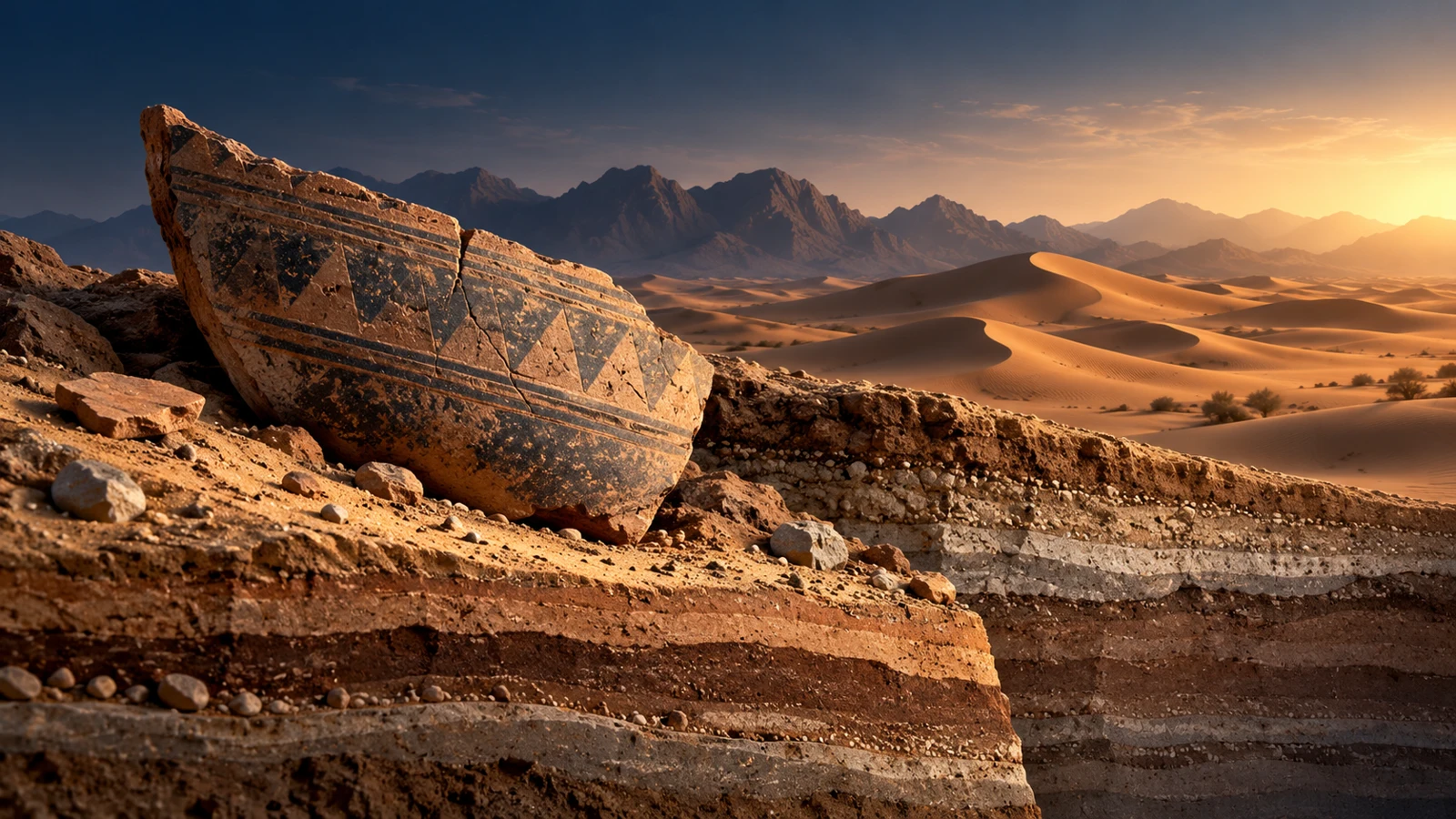
Mleiha offers a different way to read the UAE. Instead of beginning with a skyline, the visitor begins with settlement, landscape and the evidence people leave behind. A well-planned visit can connect objects in a display to the terrain outside, while avoiding the temptation to compress very different historical periods into one vague story about the desert.
This is a planning and interpretation guide, not a live booking page. Access arrangements, available tours and prices should be confirmed with the official operator for the intended date. The itinerary suggestions are editorial proposals. They are not promises that every activity can be combined into one ticket or completed within a fixed number of hours.
Separate the place, the centre and the wider landscape
Visit Sharjah places Mleiha in the emirate’s Central Region and describes an experience combining archaeology, landscape and guided activities. Its destination material connects the area with the Faya Palaeolandscape. [1] Those references should encourage visitors to understand the geography rather than use several heritage names interchangeably.
A sensible first step is to map the intended stops and ask which are accessible through the centre or an authorised guide. Distinguish an exhibition, an archaeological location and a broader landscape. They may involve different access and interpretation arrangements. The goal is a coherent visit, not a list of names collected from promotional pages. A short conversation with the operator can establish what is realistic and appropriate for the particular group.
Read heritage status precisely
UNESCO maintains a Tentative List entry titled “Mleiha, Late Pre-Islamic Center of a South-East Arabian Kingdom.” That is a specific record, submitted in 2023, and should not be casually described as the same designation as every other site mentioned in destination marketing. [2]
For visitors, the useful habit is to ask which exact place and designation a label refers to. An inscription, a tentative entry and a broader tourism district are different kinds of information. This is not merely a technical distinction. It protects historical understanding from becoming a contest over superlatives. A place can be important and worth visiting without every sentence about it being framed as an official global ranking. Use the linked records to identify what the institution actually says.
Begin with a question rather than an activity package
Choose a question that will organise the day. How did people use water? How do archaeologists infer trade from objects? What can a tomb tell us, and what can it not tell us? A focused question makes a museum stop more memorable than trying to absorb every display equally.
For a family, assign different observation tasks: one person notices materials, another looks for evidence of movement or exchange, and another records questions about the landscape. These are informal learning suggestions, not a prescribed educational programme. The advantage is that children and adults can participate without needing the same historical knowledge. Afterwards, compare observations and distinguish the things actually seen from explanations offered by the guide and ideas the group inferred for itself.
Use the centre and guided interpretation together
Visit Sharjah describes guided archaeological tours and refers to features such as an Umm an-Nar tomb and Fossil Rock in its area material. [3] Ask the operator which tours are currently available, what they include and what physical demands or access restrictions apply. A named attraction on a website should not be interpreted as permission to enter any nearby site independently.
A guide can help connect an object, its archaeological context and the wider environment. Prepare questions that invite explanation rather than just a date. For example: what evidence supports the interpretation, what has been reconstructed and which questions remain open? This approach respects the difference between a documented finding and an attractive story. It also makes a shorter visit more valuable because attention is directed toward how knowledge is established.
A flexible two-part visit
A useful editorial itinerary starts with orientation and the displays, followed by a suitable guided outdoor component where available. Leave a buffer between them for questions, refreshments and any transfer arrangements. Confirm the order with the operator; the best sequence depends on the actual programme and conditions.
Do not build the plan around an unrealistic promise to complete archaeology, a long adventure activity, a meal and several other emirates in one day. Travel fatigue reduces the attention that makes the visit worthwhile. For residents returning with guests, consider a more selective visit rather than repeating an exhausting standard itinerary. One well-understood site and a thoughtful discussion can leave a stronger impression than a large collection of photographs taken between hurried departures.
Match the physical plan to the group
Ask about walking surfaces, shade, transport, toilets, accessibility and the suitability of the selected activity for children or older participants. Confirm weather conditions and follow operator guidance. A heritage visit may include outdoor terrain even when the first stop is an indoor exhibition, so clothing and supplies should reflect the complete plan.
Set a practical boundary in advance: an optional outdoor component can be dropped without treating the day as a failure. This matters when participants have different fitness, comfort or attention levels. The aim is to preserve a good experience for the whole group. Do not assume that the strongest walker’s preferred pace is appropriate for everyone, or that a package name accurately communicates the physical effort involved. Ask concrete questions about the actual route and duration.
Photography should preserve context, not disturb evidence
Follow the site’s photography instructions and respect barriers and protected areas. A memorable image does not justify moving an object, climbing on a structure or leaving a permitted route. Ask before photographing other visitors or staff where their participation is central to the image.
For a personal travel journal, record the location, the institution and the explanation associated with a photograph. That small habit prevents images from losing their meaning after the trip. If sharing an interpretation publicly, distinguish what the official guide or display stated from your own reaction. A desert landscape can invite imaginative conclusions, but responsible cultural writing does not convert a personal impression into an archaeological fact. Accuracy makes the story more credible and gives other readers a reliable path to learn further.
Continue the learning after leaving
At the end of the visit, write three observations and three unanswered questions. Compare them with the official destination and UNESCO records. If the group has confused periods or places, resolve that confusion rather than reinforcing it through a confident social caption. This is a simple way to turn tourism into lasting knowledge.
Mleiha is especially useful within a wider UAE reading plan because it challenges the habit of treating the country’s history as only the recent transformation of its cities. The stronger lesson is methodological: landscapes, objects and institutions each reveal different kinds of evidence. A good visit makes those distinctions visible. It leaves the traveller with a richer question about the Emirates, rather than merely another destination checked off a list.
Official sources and editorial method
Sources checked on 31 October 2026. Numbered references support the official facts stated. Planning frameworks and hypothetical scenarios are CYUAE editorial analysis, not individual legal or tax advice. Conceptual imagery does not depict actual documents, properties, trails or museum exhibits.


