
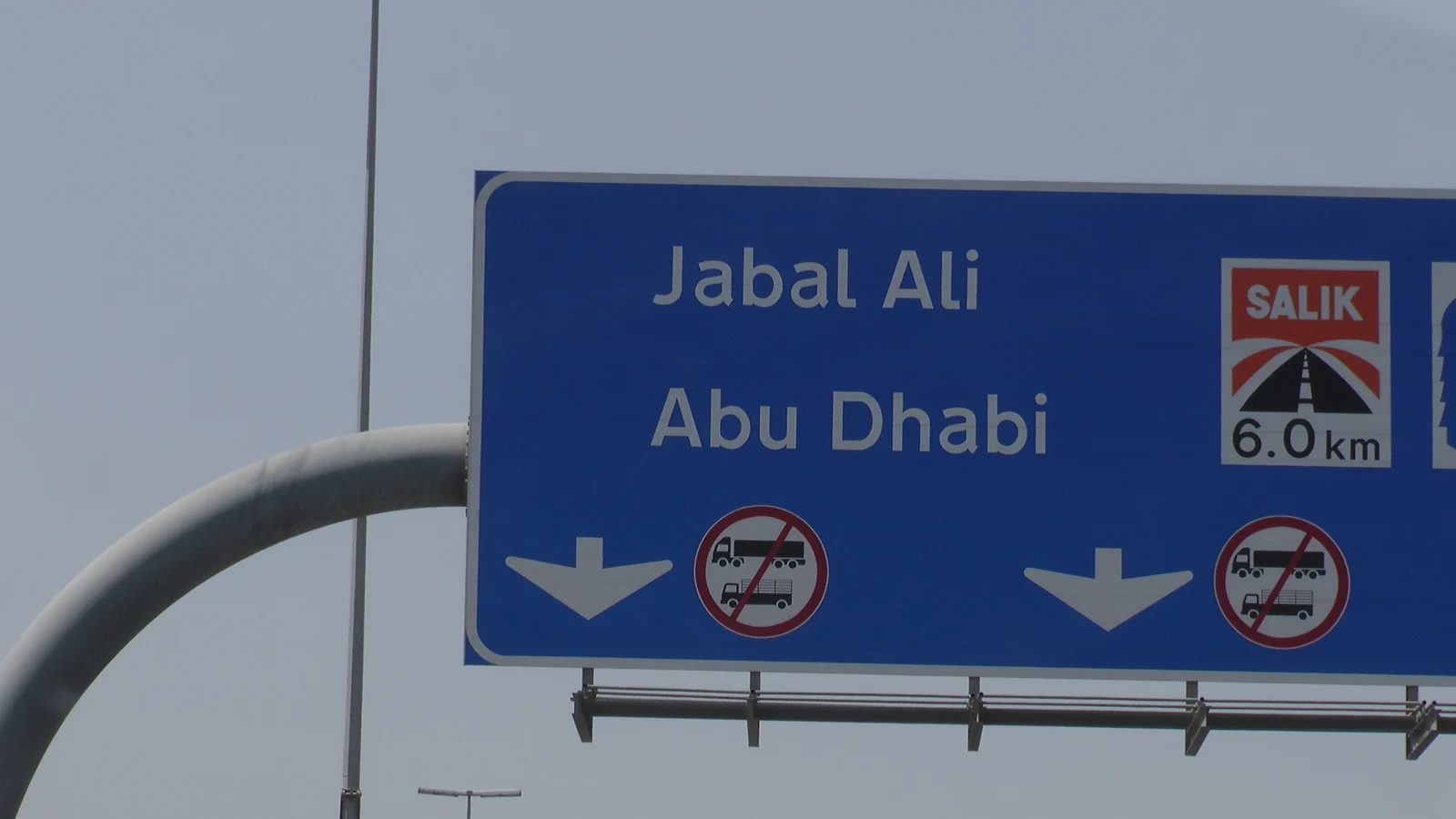
A toll budget becomes unreliable when it starts with a remembered price rather than the actual journey. In Dubai, the number of chargeable crossings, the time of each crossing and the current tax treatment all matter. Account administration matters too: a correctly installed tag does not help if the vehicle details are wrong or the account cannot cover the trips.
This guide separates the published tariff from the amount a household should budget. It then turns those inputs into a repeatable route comparison. The examples are hypothetical calculations, not claims about a particular road, employer or driver's experience. Sources were checked on 3 November 2026.
Read the current charge in two layers
Dubai's government transport information describes the normal, non-Ramadan base tariff as AED 6 during Monday-to-Saturday peak periods, AED 4 off peak and zero from 01:00 to 06:00. The peak windows are 06:00–10:00 and 16:00–20:00. Ordinary Sundays use the AED 4 base tariff outside the free window, but the operator's pricing table expressly excepts public holidays and events. Do not treat Sunday as an unconditional promise for every special day. [1][2]
Related reference: Dubai Public Transport and nol: Build a Reliable Commute Before Choosing a Travel Pass.
The second layer is VAT. Salik's company disclosure, published through Dubai Financial Market on 22 May 2026, states that 5% VAT applies to toll tariffs and tag activation fees from 1 June 2026. The underlying tariff remains unchanged. A chargeable AED 6 crossing therefore costs AED 6.30 including VAT; AED 4 becomes AED 4.20. [3]
| Normal non-Ramadan period | Base toll | Including 5% VAT |
|---|---|---|
| Monday–Saturday, 06:00–10:00 and 16:00–20:00 | AED 6 | AED 6.30 |
| Monday–Saturday, other chargeable hours | AED 4 | AED 4.20 |
| Daily, 01:00–06:00 | AED 0 | AED 0 |
| Ordinary Sunday outside the free window | AED 4 | AED 4.20 |
This table is not a Ramadan timetable. Nor does it override event-specific instructions, an account correction or a special gate rule. Check the operator's current information for the date and route. Older explainers displaying only AED 6 and AED 4 may be describing the base tariff rather than the current tax-inclusive deduction. [2][3]
Count charged crossings, not trips away from home
“Two journeys a day” is not a usable toll assumption. A single journey may encounter several gates; another route may encounter none. Build the budget from a representative week, using the account transaction record to establish the chargeable crossings actually recorded.
Create one row for each recurring movement: home to work, work to home, school collection, regular client visit and weekend activity. Record departure time, approximate gate passage time, charged crossings and alternatives. Keep exceptional trips separate so an unusually busy week does not become a false permanent baseline.
Related reference: Abu Dhabi Darb Tolls: Register the Right Vehicle and Budget the Actual Crossings.
The key distinction is between a physical gate encounter and a chargeable transaction. Do not independently assume a gate-pair exemption, direction rule or timing exception. Verify the operator's treatment and compare it with the account record. If the number does not reconcile, resolve that difference before using it to judge a new home or job.
Build a monthly budget with transparent assumptions
Consider a worker with 22 commuting days in a hypothetical month. The chosen route produces two charged crossings on the outward journey and two on the return. All four occur during the normal peak periods.
The calculation is 22 × 4 × AED 6.30 = AED 554.40. That is a toll estimate only. It excludes fuel, parking, finance, insurance, maintenance and any separately disclosed rental-company administration charges. The VAT-inclusive result is AED 26.40 above the AED 528 base-tariff calculation.
Now suppose the worker can legitimately move the return journey into an off-peak period, while the outward journey remains peak. The estimate becomes 22 × [(2 × AED 6.30) + (2 × AED 4.20)] = AED 462. The hypothetical saving is AED 92.40 per month. It exists only if the working arrangement, actual crossing times and gate count support it.
Related reference: Living in Ajman and Working Elsewhere: Build a Commute Budget Before Choosing a Home.
Do not change a safe routine merely to cross a tariff boundary. A few minutes of delay, traffic variation or an extra trip can change the result. Build a modest buffer from observed transactions rather than assuming the cheapest possible timing every day.
Compare a cheaper route with the whole journey
A toll-free alternative is valuable when its extra costs are acceptable. It is less useful when the apparent saving is consumed by additional fuel, parking, unreliable arrival times or an unsustainable family routine.
Use a simple comparison with actual observations:
| Input | Route A | Route B |
|---|---|---|
| Monthly charged crossings and tariff | Calculate from observed trips | Calculate separately |
| Fuel and distance | Use the vehicle's own consumption | Include additional distance |
| Parking | Destination and any transfer parking | Destination and transfer parking |
| Travel-time range | Record several representative days | Record the same types of day |
| Practical constraints | Work, school and care commitments | Check the same commitments |
Time has value, but households should choose their own value rather than accept a universal hourly figure. One family may prioritise a predictable school collection; another may prefer lower cash expenditure. The useful result is an honest trade-off, not a claim that one route is best for everybody.
Set up the vehicle and account before relying on the road
Dubai's official guidance explains that the Salik tag is attached to the windscreen and tolls are deducted automatically from a rechargeable account. [1] Before the first planned commute, verify the plate number, plate category, issuing emirate, linked vehicle and contact details in the official service. Follow the supplied installation instructions.
Then confirm that activation succeeded. Keep the confirmation and use the first recorded transactions to test the setup. An order receipt, a sticker in the car and an activated vehicle record are different pieces of evidence. A small administrative error should be corrected while it is still a small administrative error.
Keep account access under the control of someone who can act promptly. If a household member manages payments, agree who checks the balance and who receives alerts. If a company administers the vehicle, establish how employees report a changed plate, replacement car or disputed deduction.
Do not use a grace period as a payment routine
Dubai's published Salik implementing resolution specifies ten working days to register after an unregistered crossing and five working days to fund an account after an insufficient-balance crossing. The RTA's driving handbook also describes ten working days for obtaining and installing a tag, and five working days for resolving insufficient funds. [4][5] These are different situations, not a single general extension.
The practical response to an unexpected crossing is to check the official account immediately, complete the relevant action and retain proof. Do not wait until a remembered deadline or assume weekends and public holidays are counted like ordinary elapsed days. Ask the operator to confirm the applicable deadline if the starting event or account status is unclear.
This guide does not reproduce an old fine schedule. Financial consequences and dispute eligibility should be read in the current account and operator guidance, with the original transaction date preserved. A recharge receipt is useful evidence; confirm that the pending trips have also been reconciled.
Treat a sale, rental or plate change as an account event
The RTA handbook instructs drivers to notify Salik when selling a vehicle or changing the plate or mobile number. It also warns against moving a tag to another vehicle or using the previous owner's tag. [5] Ownership paperwork and toll-account administration should therefore be handled as connected tasks.
For a private sale, make a written handover checklist: vehicle transfer, tag removal or deactivation, account update and evidence of completion. Check for unexpected transactions afterwards. For a rental, read the contract's toll charging and administration terms before comparing prices. Ask how usage is itemised, when it is billed and what evidence supports a disputed amount.
A company-car driver should know whether the employer pays every business crossing, requires a claim or excludes private journeys. Keep the account statement and reimbursement policy aligned. Do not turn a missing internal approval into a claim that the toll itself was charged incorrectly.
Questions drivers should resolve before the next month
Is Salik free on Sundays?
The normal schedule has a chargeable Sunday tariff outside the daily free window. The operator also flags public-holiday and event exceptions. Check the date-specific rules rather than assuming a free weekend. [2]
Should a monthly budget use AED 6 or AED 6.30?
For a normal chargeable peak crossing after 1 June 2026, use AED 6.30 including 5% VAT. Keep base tariff and tax separate in the calculation so later changes are easy to audit. [3]
Does moving money into the account prove a disputed trip was corrected?
No. Check the trip and account record after payment. The relevant question is whether the identified outstanding transaction or alleged error was resolved, with a reference that can be followed up.
What is the best way to reduce the cost?
Measure first. Compare charged crossings, lawful working flexibility and genuinely workable alternatives. A lower toll figure is useful only when the complete journey remains affordable, reliable and safe.
Official sources and editorial method
Sources checked on 3 November 2026. Numbered references support the official facts stated. Planning frameworks and hypothetical scenarios are CYUAE editorial analysis, not individual legal or tax advice. Photographs are contextual; image credits identify their source and licence. They do not document a particular application or case.
- Dubai Government — Road toll in Dubai (Salik) ↗
- Salik Annual Report 2025 — Operational review and variable pricing ↗
- Salik company disclosure to Dubai Financial Market, 22 May 2026 — VAT effective 1 June 2026 ↗
- Dubai Legislation Portal — Administrative Resolution No. 210 of 2009, Articles 13 and 14 ↗
- RTA — Light Motor Vehicle Handbook, Salik account administration ↗


