
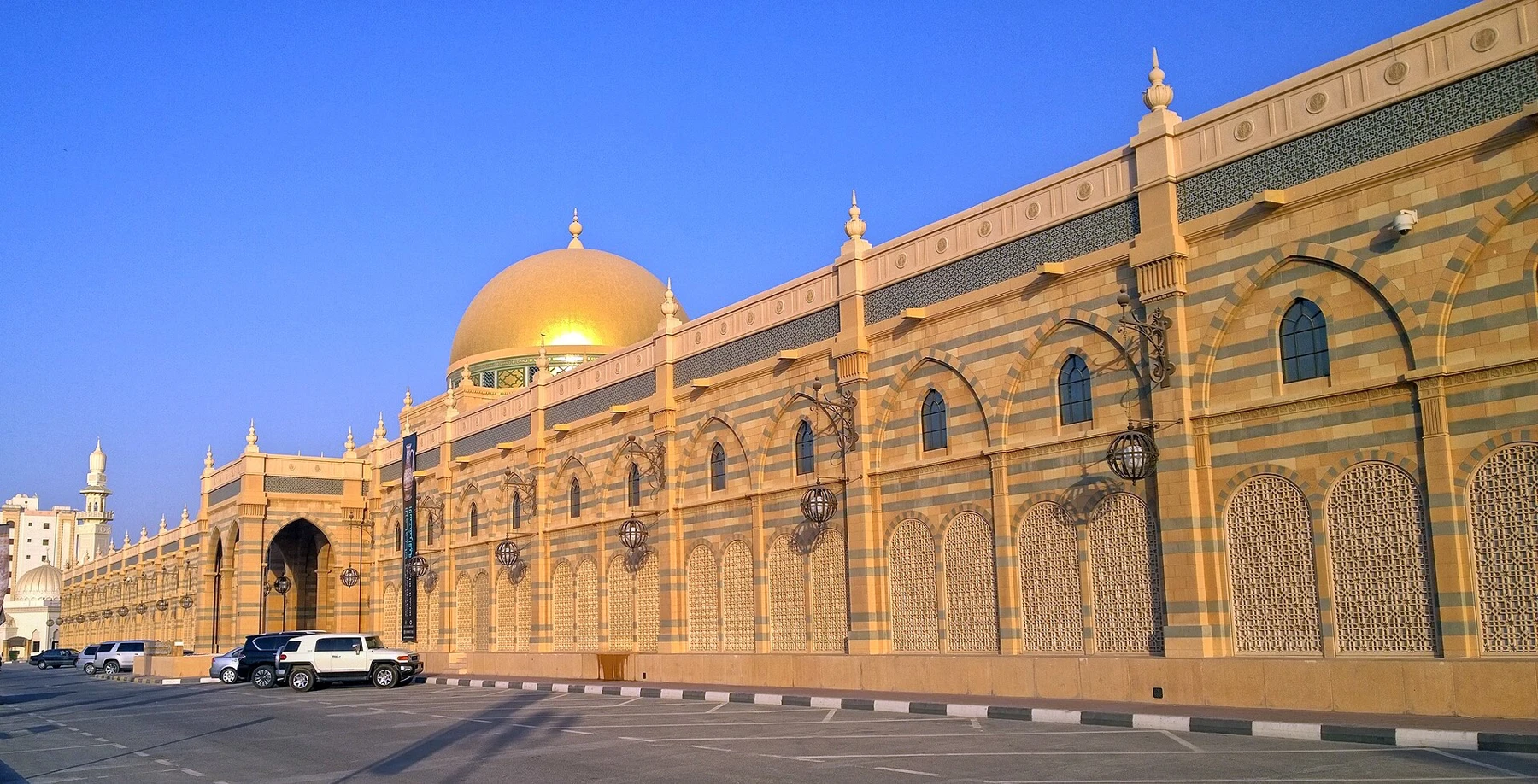
Contemporary art can make a visitor uncertain in productive ways. An installation may withhold a simple explanation, a film may require more time than a passing glance, and a building may be part of the experience rather than a neutral container. In Sharjah, those possibilities make planning a cultural visit an exercise in attention as well as transport and tickets.
Sharjah Art Foundation offers a useful setting for learning how to approach that experience. This guide explains how to choose a visit, read an exhibition responsibly and connect the work with the spaces in which it appears. It is intended for residents, first-time visitors and families. The interpretive framework is editorial; current exhibitions, access arrangements and programmes must be checked with the Foundation itself.
Begin with the programme that is actually open
The Foundation describes a programme supporting contemporary-art production, presentation and research, including exhibitions, the Sharjah Biennial, March Meeting, grants, residencies and publications. [1] That range is important because the organisation should not be reduced to one recurring event or one well-known installation. A visitor needs to establish what is available on the intended date.
Use the official visit information and venue listing together. The Foundation notes that some venues may not be open when they are not hosting an exhibition. [2][3] A building appearing on a map is therefore not the same thing as a confirmed opportunity to enter it. Identify the specific exhibition, its venue and its practical requirements before constructing the day around it.
Keep a copy of the relevant details or booking acknowledgement where required. If plans change, check the official programme again. A photograph or article from a previous edition can be useful cultural context, but it is not evidence that the same work remains on display. Separating programme history from present access prevents avoidable disappointment and more accurate travel writing.
Decide how much attention the work requires
A painting, a film, an archive and an immersive installation can demand different amounts of time. A visitor who treats every room as a quick visual stop may miss work whose meaning depends on duration, sequence or repeated observation. Planning should therefore begin with the mode of engagement, not simply the number of venues.
Before arriving, ask what type of work is involved and whether any part has a scheduled start or particular entry arrangement. Leave room for a work to take longer than expected. If the programme includes moving-image work, decide whether the group is willing to remain for a meaningful section rather than entering for a minute and evaluating a fragment as though it were complete.
Attention has a physical component too. People become tired, distracted or overstimulated at different rates. A well-designed visit includes a place for a break and an agreement that participants need not respond identically. The objective is serious engagement, not proof that everyone can endure the longest possible itinerary.
Use three readings before deciding what an artwork means
Start with a direct reading: what is present? Notice material, scale, sound, movement, light and the relationship between elements. Then read the supplied information about the artist, work and context. Finally consider your interpretation. These stages can overlap, but distinguishing them prevents the label or a companion’s opinion from completely replacing personal observation.
A useful question is whether the interpretation explains what is actually encountered. If the work contains repetition, interruption or a change of material, ask what that feature contributes. Avoid forcing a grand political or psychological conclusion onto every visible detail. Sometimes the most accurate response is a focused question whose answer requires more context.
The method also protects against the opposite error: deciding that unfamiliar work has no meaning because it does not immediately offer one. Uncertainty is not proof of quality, but it is not proof of emptiness either. Give the object and the institution’s information an attentive reading before reaching a conclusion. A thoughtful judgement can remain critical without becoming dismissive.
Distinguish the artist’s statement, the curator’s framing and your response
An exhibition can contain several voices. The artist may describe an intention; the curator may place the work in a broader argument; a publication may introduce research; the visitor may form a personal association. Those voices can reinforce or complicate one another. They should not be collapsed into one supposedly obvious meaning.
When discussing the visit, use accurate attribution. “The exhibition text proposes” is different from “the work proves.” “I read this as” is different from claiming that the artist has confirmed your interpretation. These distinctions create a more honest cultural conversation. They make space for disagreement without requiring one participant to pretend that their immediate reaction has institutional authority.
For a writer, this is particularly important. A public caption may circulate far beyond the visitor’s original context. Preserve the subject and qualification of a statement. If a work prompts a personal reflection on migration, memory or labour, present that as a reflection unless the exhibition provides evidence for a more specific claim.
Let the venue contribute to the enquiry
The Foundation describes its reuse of historical structures as part of its network of cultural spaces. [3] That institutional approach invites attention to thresholds, courtyards, circulation and the relationship between new work and existing architecture. The building can influence how a viewer encounters an exhibition without making every architectural feature part of the artwork.
Ask how the route changes perception. Does a quiet room follow a public courtyard? Does natural light alter the viewing experience? Does the scale of a work respond to the space? These are observations, not automatic conclusions about the artist’s intentions. Where the relationship is central to an interpretation, consult the exhibition material or ask a guide.
Avoid romanticising every reused building as an untouched historical environment. Adaptation involves choices about conservation, access and contemporary use. A visitor can appreciate those choices while asking how they shape the experience. This produces a richer account than treating architecture as a decorative backdrop for photographs.
A first-time visitor’s practical sequence
Choose one current exhibition and establish its venue and entry requirements. Arrive with enough time to orient yourself rather than rushing directly to the most photographed work. Take a first pass without trying to extract a complete explanation. Then read the available material and return to one or two works that raised questions.
If a guided tour is suitable, request it through the official process and confirm the arrangement. The Foundation’s visitor page explains its tour options and practical conditions. [2] A tour should deepen observation, not relieve the visitor of looking. Bring specific questions about a material, method or contextual claim rather than asking only what the work is “supposed to mean.”
End with a short reflection. Which work changed after the second look? Which explanation helped? Where did you remain unconvinced, and why? A critical response supported by observation is a successful outcome. The point is not to leave liking everything; it is to understand the basis of your own judgement more clearly.
Family visits: replace the pressure to understand with permission to observe
Children can respond to colour, scale, sound and repetition before they know the vocabulary of contemporary art. Give them concrete tasks: find a material used unexpectedly, notice how a sound changes in different locations, or describe what appears different after moving around a work. Follow venue rules and never turn observation into permission to touch an installation.
Keep conversations open. Ask what was noticed before asking what it means. Adults sometimes rush to provide a clever explanation, unintentionally teaching children that cultural confidence means always having an answer. It is more useful to demonstrate how to look, read and revise an idea when new information appears.
Select a manageable duration and confirm which experiences are suitable for the group. Some works may include content, darkness, sound or a mode of participation that requires consideration. Ask the institution about specific needs instead of assuming a broad family-friendly label answers every question. The quality of attention matters more than the amount of territory covered.
Photography, participation and professional boundaries
Check the Foundation’s current photography guidance. Its visitor page distinguishes personal phone photography from professional photography requiring prior permission. [2] The existence of an engaging visual subject does not remove the need to follow rules, respect other visitors or obtain an appropriate permit for a professional project.
When a work invites participation, read the instructions carefully. Participation in one installation does not establish that every object in the building can be handled. If uncertain, ask. An artwork’s accessibility depends partly on visitors protecting the conditions that allow others to experience it.
For social sharing, identify the artist and work accurately where that information is available and relevant. Avoid cropping away all context and then attaching an invented story to the image. Consider whether another visitor is recognisable and central to the photograph. Cultural participation should not come at the expense of someone else’s privacy or the integrity of the work.
A notebook for a more demanding cultural response
A concise notebook can make an exhibition more memorable without turning the day into academic administration. Record one observation, one institutional explanation and one question for each selected work. The separation helps distinguish what you saw from what you were told and what you inferred.
| Stage | Question | Useful evidence |
|---|---|---|
| First encounter | What is materially present? | Scale, material, sound, sequence |
| Context | What does the supplied text establish? | Artist, date, process, stated subject |
| Interpretation | How do the features support a reading? | Specific connections to what is present |
| Critique | What remains unconvincing or unclear? | A precise gap, rather than a general dismissal |
| Follow-up | What could resolve the question? | Publication, tour, artist discussion or further research |
The notebook is also a control against overconfidence. If a claim cannot be connected to a work, an institutional source or a clearly labelled personal inference, it may need revision. This standard makes cultural writing more persuasive because readers can follow the route from observation to judgement.
A hypothetical comparison between two visitors
Imagine two friends visiting the same installation. One responds strongly to its atmosphere; the other finds it obscure. Neither response is inherently wrong. The useful next step is to ask which features produced the reaction and whether the exhibition’s context changes it. They may still disagree after a second viewing, but the disagreement becomes informative rather than a competition in confidence.
The first visitor might discover that an emotional response was connected to a personal memory rather than the work’s stated subject. The second might recognise a structural detail that was missed initially. Both have learned something, even if neither changes their final preference. A cultural visit does not require consensus.
This is one reason to avoid a tightly scheduled itinerary that leaves no time for discussion. Art can function as a shared object around which different experiences become visible. The institution supplies the setting and information; the visitors supply attention and a willingness to examine how their own interpretations are formed.
Connect a visit with Sharjah’s wider cultural life
A contemporary exhibition can be read alongside other cultural institutions in the emirate, but comparison should preserve difference. Historical museums, archaeological sites, performance venues and artist-led programmes organise knowledge in distinct ways. The most productive itinerary asks what each place adds rather than treating them as equivalent attractions.
A resident might return over several months, comparing how different exhibitions use archival material or sound. A traveller might pair one exhibition with a heritage walk and ask how the built environment is interpreted in each. These are editorial suggestions, not claims that particular programmes are always available together.
The deeper value is continuity. Cultural understanding grows through repeated encounters, correction and further reading. One ambitious day can introduce a subject, but a sustained habit of looking often produces more. Sharjah offers an opportunity to develop that habit if visitors approach the programme as an evolving conversation rather than a permanent catalogue.
Questions visitors frequently ask
Do I need specialist knowledge before visiting?
No. Begin with observation and use the supplied context. Specialist vocabulary can help later, but it should not replace attention. A clear question about a visible feature is often more useful than an impressive term used without understanding.
Is a biennial always running?
Do not assume that a recurring initiative is a permanent exhibition. Consult the current official programme, dates and venues. An organisation can maintain year-round activity while the particular event you have read about belongs to another period.
Can I visit every venue on the map?
Check current access for each one. The official venue information notes that some spaces may be closed when they are not hosting an exhibition. A published building name is not itself confirmation of entry on a particular day.
What if I dislike the exhibition?
Ask why. A response grounded in specific observations is legitimate. Distinguish lack of personal connection from a claim that the work is meaningless, and remain willing to revise a judgement when the evidence changes.
What a successful visit leaves behind
A strong contemporary-art visit leaves the traveller more attentive and more precise. It may produce enjoyment, discomfort, disagreement or a new research question. What matters is that the response has a discernible basis and that the visitor can distinguish observation, context and inference.
Sharjah Art Foundation is best approached as a changing programme of encounters. Use the official information to establish what is accessible, then give the work the time its form requires. Respect the space, the other visitors and the limits of your interpretation. The resulting experience can be intellectually demanding and personally rewarding without becoming a performance of expertise. It makes culture part of an active relationship with Sharjah rather than a decorative addition to a travel schedule.
Official sources and editorial method
Sources checked on 31 October 2026. Official facts are distinguished from CYUAE analysis and clearly labelled hypothetical examples. Confirm current access, eligibility, fees and service requirements with the responsible institution before acting.



