
Ajman Museum can reward a visitor who slows down. The building, recreated environments and objects offer several ways to investigate everyday life, authority, trade and memory. A strong visit does not need to turn every display into a claim about the whole UAE. It begins by asking what this particular institution reveals about Ajman and how that evidence fits a wider national story.
This is an interpretive planning guide rather than a current ticket or opening-hours listing. Confirm access, programme and visitor arrangements with the museum or the official tourism authority for the intended date. The proposed route through the material is editorial; it does not promise a fixed display sequence or the continued availability of a particular installation.
Begin with the building as evidence
The Ministry of Culture describes the museum in Al Nuaimi Fort and records its use as a ruling-family residence until 1970, followed by a period as police headquarters. It identifies the museum’s restoration and opening in 1991. [1] These changes make the building part of the story rather than just a decorative container for objects.
Notice where the architecture suggests defence, gathering, administration or private life, while distinguishing observation from a conclusion that requires expert explanation. Restoration also matters: ask what has been conserved, reconstructed or adapted for visitors. A historic building can communicate several periods at once. Treating every visible feature as original to one moment can obscure the institution’s more interesting account of change and reuse.
Do not force conflicting summaries into one precise date
Official cultural and tourism summaries describe the fort’s chronology and museum development in somewhat different ways. The Ministry of Culture account and the National Cultural Map entry should therefore be read as specific institutional descriptions rather than collapsed into an unsupported single construction date. [1][2]
For a visitor, the useful response is curiosity rather than an invented resolution. Ask the museum how it presents the building’s phases and which sources support that account. Heritage structures often undergo repeated additions, repairs and changes of use. A careful writer can report those phases without pretending that every wall belongs to the same year. This approach is especially important when preparing school material or a public travel article: uncertainty should be acknowledged where the evidence consulted does not settle it.
Use maritime life as one organising theme
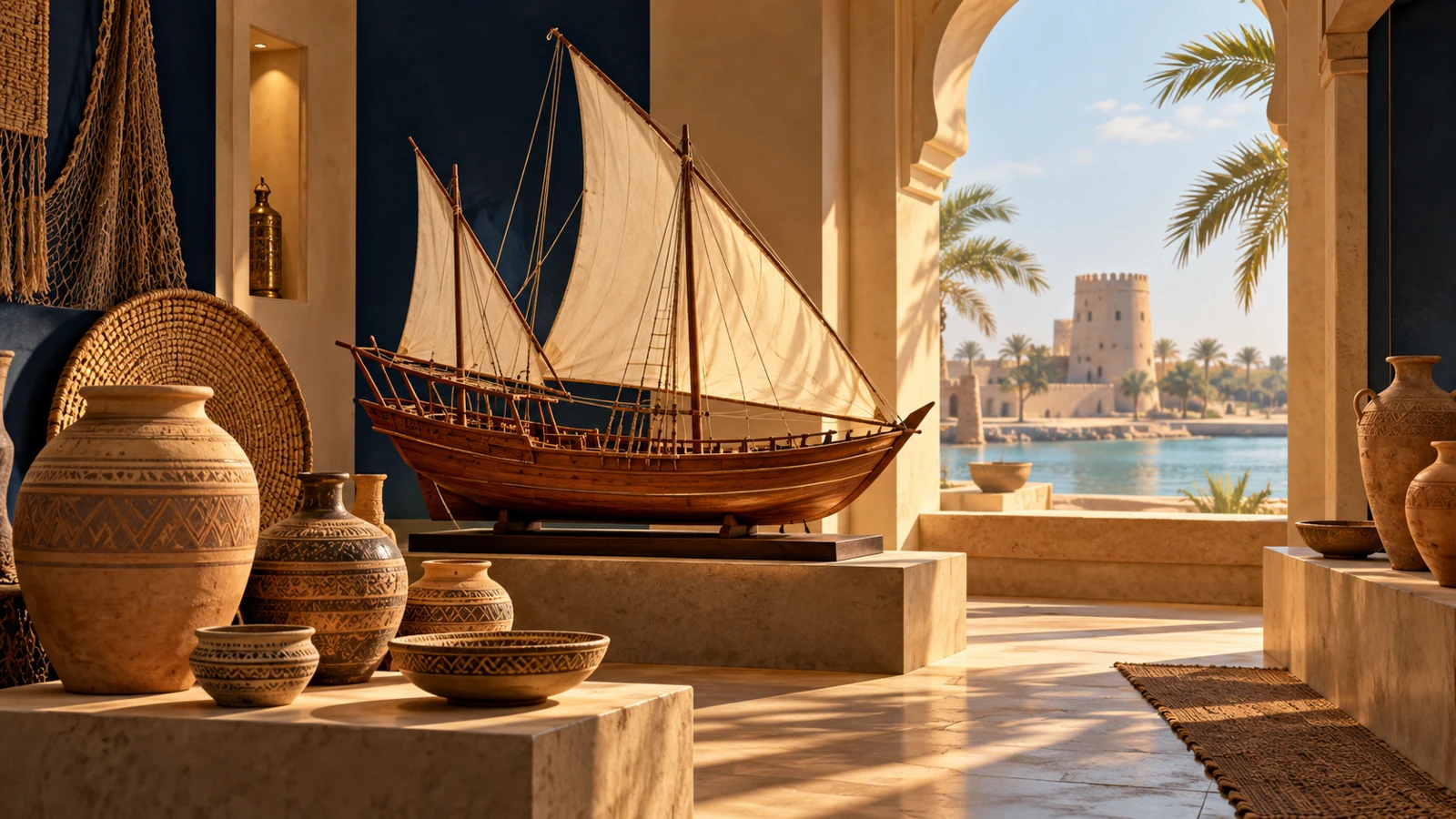
The National Cultural Map highlights material connected with dhows, irrigation, archaeology and the pearl trade. [2] These themes invite a question about how people combined sea, land, work and exchange, rather than a simple contrast between a poor past and a wealthy present.
Look for the relationship between an object and the activity it supported. What skills did a boat require? Which people performed different tasks? What information is provided about risk, seasons or trade? Do not assume that one exhibit represents every household or every period. The purpose is to move from an attractive object to a supported explanation of its use. That habit creates a more precise understanding of heritage than collecting labels without considering the social and economic relationships behind them.
Distinguish artefacts, reconstructions and interpretation
The Ministry of Culture describes recreated environments and life-size models among the museum’s presentation methods. [1] A reconstruction can be valuable because it helps a visitor imagine how objects and activities related to each other. It should still be recognised as an interpretive presentation rather than mistaken for an untouched historical scene.
When walking through a display, separate three layers: the physical evidence, the institution’s explanation and your own response. A family can discuss these layers in ordinary language. “This is what we saw,” “this is what the label says,” and “this is what we think it might mean” are useful distinctions. They do not make a museum visit dry. They make it possible to be imaginative without turning imagination into a claim that the historical evidence cannot support.
A family visit organised around observation
Choose a few themes instead of demanding that children absorb every room. One participant might look for tools, another for materials and another for signs of trade or water use. Pause after several displays to compare what each person noticed. These are informal learning suggestions, not a museum-prescribed programme.
Allow questions to remain unanswered until a suitable guide or display can address them. Adults often feel pressure to explain everything immediately, which can lead to confident but unsupported stories. It is better to record a question and investigate it later. Give the visit enough breathing room for participants to change their focus. A child who becomes interested in one object may learn more from a careful discussion of that object than from being hurried through the entire institution.
Connect the museum to the surrounding city carefully
The National Cultural Map locates the museum in Al Bustan by the central square. [2] Use that location as a starting point for a visit plan, then confirm current transport, parking and access arrangements. Do not assume that historical references or older visitor PDFs establish today’s practical conditions.
If combining the museum with another Ajman stop, plan the transition so the cultural visit does not become an afterthought between meals and shopping. A short conversation after leaving helps connect the exhibits to the emirate being visited. Keep that discussion specific. The modern city is not a museum reconstruction, and contemporary residents should not be treated as evidence for a visitor’s preferred story about the past. Heritage offers context; it does not reduce a living place to a set of timeless characteristics.
Photograph and share with accurate captions
Follow the museum’s instructions concerning photography and protected areas. If a display has a useful title or explanation, note it for personal reference where permitted. A photograph without context can easily be mislabelled when shared later, particularly if it depicts a reconstruction or an object from a period unfamiliar to the visitor.
For public captions, identify the institution and avoid presenting a personal inference as an official interpretation. Do not call an object the oldest, largest or most important unless an authoritative source supports that precise claim. Superlatives rarely improve a cultural account as much as an accurate explanation of what the reader is seeing. A clear, modest caption can lead someone to the actual institution and its evidence rather than merely amplifying an attractive but unsupported story.
Leave with a stronger account of Ajman
A useful end-of-visit exercise is to identify one thing learned about the building, one about everyday work and one about the methods used to present the past. Add an unanswered question and the official source that might help resolve it. This turns a visit into a small, structured act of learning.
Ajman Museum adds depth to a UAE itinerary because it encourages attention to a particular emirate rather than repeating a generic national overview. Its value is not that every exhibit provides a complete answer. Its value is that the fort, collections and interpretations open a route into better questions about work, authority, exchange and memory. The visitor who follows that route leaves with more than photographs: they leave with an account of how their understanding was formed.
Official sources and editorial method
Sources checked on 31 October 2026. Numbered references support the official facts stated. Planning frameworks and hypothetical scenarios are CYUAE editorial analysis, not individual legal or tax advice. Conceptual imagery does not depict actual documents, properties, trails or museum exhibits.


