
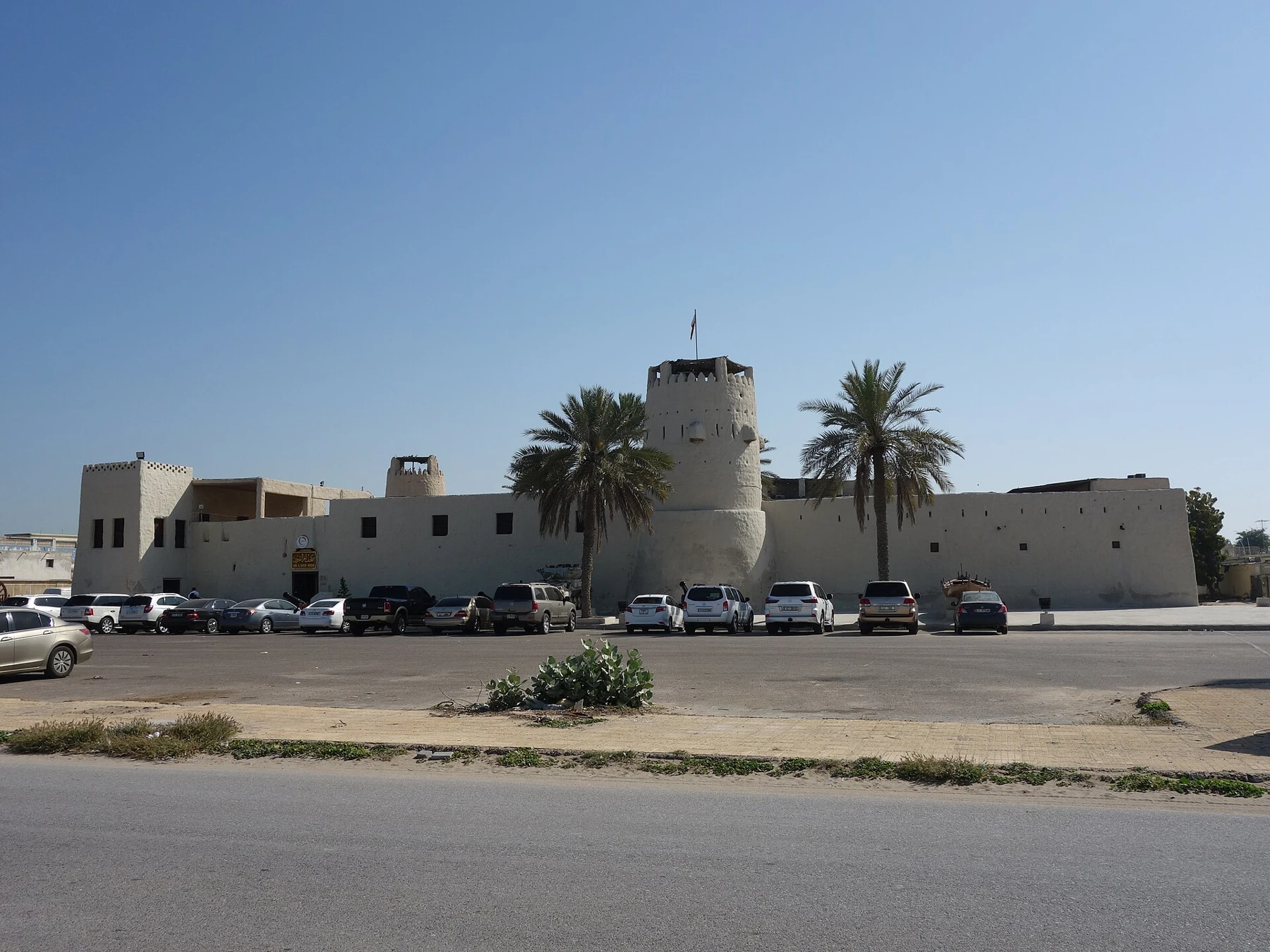
An understanding of Umm Al Quwain that stops at the coastline remains incomplete. Falaj Al Mualla opens a route into the emirate’s inland geography and the relationship between settlement, cultivation, protection and daily work. Its fort and museum encourage the visitor to ask how an inhabited landscape functioned, rather than treating a heritage building as an attractive object detached from the people and activities around it.
The Ministry of Culture places the fort in an oasis associated with date palms, lemons and vegetables. It describes a defensive building with towers, rooms, a courtyard and a date-processing space. The National Cultural Map identifies museum material connected with crafts, maritime activity and everyday life. [1][2] These concise facts provide the basis for this guide. The proposed itinerary and interpretation methods are editorial suggestions, subject to current access and institutional instructions.
Begin by changing the geographical frame
A coastal emirate can contain inland places with different relationships to land, movement and resources. Falaj Al Mualla is useful because it challenges a visitor’s tendency to treat an emirate as one city and one landscape. The first preparation step is therefore a map that distinguishes the intended destination from the coastal urban area and allows realistic travel time.
Do not infer current road conditions, opening arrangements or journey duration from a general heritage account. Confirm practical information for the intended date and group. A thoughtful inland visit needs enough time for orientation and interpretation, not merely a brief pause between two better-known destinations.
The geographical shift also improves the historical questions. Instead of asking only how people used the sea, the visitor can ask how cultivation, movement and protection contributed to an inland settlement. These questions should be answered through the institution’s account and evidence, not through an invented contrast between separate “desert” and “coastal” populations assumed to have lived in isolation.
Read the fort as a working arrangement of space
A fort is more than a defensive silhouette. Its spaces can raise questions about access, observation, storage, gathering, administration and everyday occupation. The Ministry of Culture describes a square arrangement with towers and rooms overlooking an internal courtyard. [1] Use that description as an introduction, then ask the institution how particular features are interpreted.
A visitor can observe the relationship between an entrance and a courtyard, or between a tower and the surrounding landscape. The proposed historical function of each feature requires a further explanation. Keep those levels distinct. A room that looks suitable for storage to a modern observer should not be labelled a storehouse without support.
Walk slowly enough to understand circulation. Which spaces lead to others? Where do thresholds change the experience? How might different activities have coexisted? These are useful observational questions even when the answers remain provisional. They make architecture intelligible as an arrangement for human purposes rather than a collection of photogenic walls.
Building materials reveal a chain of decisions
The official architectural account refers to stone, gypsum, timber and palm-related roofing materials. [1] Such details can lead to questions about sourcing, construction knowledge, maintenance and adaptation to conditions. Avoid assuming that a material was chosen for one reason simply because that reason seems plausible today.
A useful discussion separates the material itself from the argument about its use. Ask whether a visible element is original, restored or reconstructed and how the institution distinguishes those categories. Restoration can be essential to preservation while also requiring careful explanation for visitors. A well-maintained heritage place should not be mistaken for an untouched survival of a single historical moment.
For an educational exercise, choose one material and trace the questions it creates: where it came from, how it was prepared, what skill was needed to install it and what maintenance might have followed. These are prompts for research, not claims about a documented supply chain at the fort. They connect the building to labour and knowledge without inventing details that the sources do not establish.
Use the madbasa to connect agriculture and household economy
The fort’s date-processing space and the museum’s presentation of date syrup provide a starting point for considering how a crop becomes a usable product. [1][2] The interesting question is the process: collection, handling, transformation, storage and use. A display can help visitors understand that food production involves organised knowledge and equipment, not simply the presence of trees.
Ask which parts of the process are represented and which are explained verbally or through labels. If a demonstration or reconstruction is offered, distinguish it from an original archaeological context. Do not assume that the procedure was identical across every household, place or period. A local example is valuable precisely because it can be examined in its own setting.
A family discussion can connect this material with familiar questions about food today. What work happens before a product reaches the table? Which tasks require timing or skill? What evidence would explain how the product was stored or exchanged? The comparison should illuminate labour and decision-making without suggesting that a modern kitchen is a direct equivalent of the historical arrangement.
The maritime exhibits complicate a simple inland story
The Cultural Map describes a Sea Room and material connected with fishing, diving and trading vessels. [2] Their presence invites a question about the relationships through which inland and coastal lives were connected. It should not be used to invent a particular family history or trade route without supporting evidence.
Read each display in relation to the museum’s explanation. A vessel model may help communicate form or function, but it is not the same kind of evidence as an excavated object or an original tool. Ask how the exhibit was assembled and what it is intended to teach. The distinction between an object, a model and a reconstruction makes the account more accurate.
This combination of inland architecture and maritime interpretation is one reason the visit can be especially useful. It discourages an overly neat division of the emirate into separate worlds. The visitor can investigate how institutions present a connected heritage while still preserving the differences between activities, locations and periods.
Everyday crafts deserve the same attention as major structures
Tools associated with sewing, personal care, adornment and clothing can be easy to overlook after a visitor has photographed a tower. Yet they can make a heritage account more human by directing attention to daily work and practical knowledge. The museum directory identifies such material among its collections. [2]
Choose a small number of objects and ask what the display establishes about their use. Consider the relationship between making, maintaining and using them. Avoid assigning social roles from appearance alone. A familiar-looking tool can tempt a modern reader into assumptions that the institution has not made.
For children, one productive exercise is to identify what problem an object appears to address and then check that idea against the label or guide. The correction is part of the learning. It demonstrates that observation can generate a hypothesis while evidence is needed to assess it. The result is more engaging than memorising an object’s name without understanding why it mattered.
A practical route through the visit
Begin with the building and its wider setting, then move to the exhibits that explain production and daily life. Leave time to connect those observations at the end. Confirm the actual display order and available interpretation with the institution rather than expecting the museum to follow an itinerary written elsewhere.
For a mixed-age group, plan pauses and a realistic number of themes. A useful visit could focus on three questions: how the place was protected, how resources were processed and how everyday skills are represented. Trying to cover every object with equal attention can leave the group with less understanding, not more.
Do not attach a fixed timetable to the experience without knowing the participants and current programme. An architectural discussion, a family observation task and a specialist guided explanation can require very different amounts of time. The aim is to preserve attention and curiosity. A shorter, well-organised visit can be more valuable than an exhausting attempt to see everything.
Confirm accessibility and comfort before departure
Ask about surfaces, steps, walking distances, seating, toilets, shade and the availability of assistance relevant to the group. A historic structure can present practical conditions that differ from those of a modern exhibition hall. The current institution is the appropriate source for those details.
Clothing and supplies should reflect the complete day, including travel and any outdoor component. Follow weather information and official instructions. If a planned part of the visit is unsuitable for a participant, adjust the route rather than treating that person’s concern as an inconvenience. A shared cultural outing succeeds when the whole group can engage comfortably and respectfully.
The same preparation applies to school or organised groups. Confirm booking requirements, group size, supervision and the form of interpretation before arranging transport. A public directory is a starting point for enquiry, not an agreement that staff will be available to provide a particular programme at an unconfirmed time.
Keep the date and source of practical information
Opening arrangements, admission conditions and programmes can change. Record when the institution confirmed the practical plan and through which channel. Avoid turning one visit’s experience into a permanent public instruction. A useful travel account can distinguish historical interpretation from current visitor information.
If writing for others, link the official sources and encourage confirmation for the intended date. This is especially important where older tourism documents and newer institutional pages differ. Do not resolve a discrepancy by choosing the most convenient detail without explanation. Ask the responsible institution or state the uncertainty clearly.
A reliable itinerary is one whose critical assumptions can be checked. The reader should know which organisation controls access and where to find further information. That is more useful than an apparently complete list of hours and prices whose accuracy cannot be established. Good planning preserves the path to a current answer instead of pretending the answer will never change.
Compare Falaj Al Mualla with the coastal fort carefully
A comparison with Umm Al Quwain’s coastal heritage can be productive if each place retains its own identity. Begin with geography, the institution’s account of function and the evidence presented. Do not assume that similar architectural features establish identical purposes or histories.
A comparison table might contain location, spaces, stated uses, materials, collections and questions still unresolved. Mark the source for each entry. The empty cells are informative: they reveal where the visitor knows something about one place and has assumed the same thing about the other. A comparison should make those assumptions visible rather than conceal them.
The strongest outcome is a more layered understanding of the emirate. A fort can be defensive, residential, administrative and later interpretive across different phases, but the actual account must come from the relevant source. The visitor learns to recognise change over time and to avoid treating every heritage building as a timeless representation of one uniform past.
A reflection exercise after the visit
Ask each participant to identify one relationship they now understand more clearly. It might be the connection between a building and its surroundings, between cultivation and processing, or between an exhibit and the work it explains. Then ask what evidence supported that understanding and what question remains.
This exercise helps separate learning from the feeling of having completed an itinerary. A museum can be enjoyable without every object being remembered. The more durable gain is an improved way of looking: recognising that architecture, tools and collections are traces of decisions and activities that require interpretation.
For a written account, use those relationships as the structure. Explain a small number of well-supported points rather than listing everything seen. Include accurate captions and source links. Where the institution offers a particular interpretation, attribute it. Where the article offers a personal response, identify it as such. That clarity gives the reader a way to continue the enquiry independently.
Notice the institution’s work as well as the historical material
A heritage visit is also an encounter with the modern work of preservation and interpretation. Decisions about restoration, display, labels, lighting and visitor movement shape what can be understood. Ask how the institution distinguishes a historical element from an intervention made to preserve it or communicate its meaning. That question respects the people whose work makes the experience possible.
A restored space should not be dismissed as inauthentic simply because it has been maintained. Equally, a visually convincing reconstruction should not automatically be treated as original evidence. The useful distinction concerns what the intervention does and how transparently it is explained. A label or guide can make that relationship clear, allowing visitors to appreciate both the surviving material and the professional decisions around it.
For a personal travel record, note one example of interpretation that helped understanding. It could be an arrangement of tools, an explanation of a process or a comparison between phases of the building. Then ask what would have remained unclear without that explanation. This draws attention to museums as active knowledge institutions rather than passive storage rooms. It also helps a visitor recognise why careful captions and qualified language matter when the experience is later retold to others.
The result is a more complete account of the place: its earlier uses, the material that survives and the contemporary work through which that material becomes accessible to the public. Those layers should remain connected without being confused.
Frequently asked questions
Is Falaj Al Mualla simply a detour from the coast? It deserves to be understood as a destination with its own inland setting and heritage questions. Plan enough time to engage with that context rather than treating the journey as a quick photograph stop.
Can a visible feature be labelled from appearance alone? Observation is useful, but the historical function of a room or structure should be checked against the institution’s interpretation and evidence.
Are museum models historical objects? A model can be an interpretive tool. Identify the distinction between original material, a reconstruction and a model, because each supports different kinds of conclusions.
Should visitors rely on older opening-hours lists? Confirm the current arrangements directly. This article does not provide a live admission or programme schedule.
What is a good first-visit theme? The relationship between protection, production and daily work offers a manageable structure. Adapt it to the displays and explanations available on the day.
Official sources and editorial method
Sources checked on 31 October 2026. Official facts are distinguished from CYUAE analysis and clearly labelled hypothetical examples. Confirm current access, eligibility, fees and service requirements with the responsible institution before acting.



