
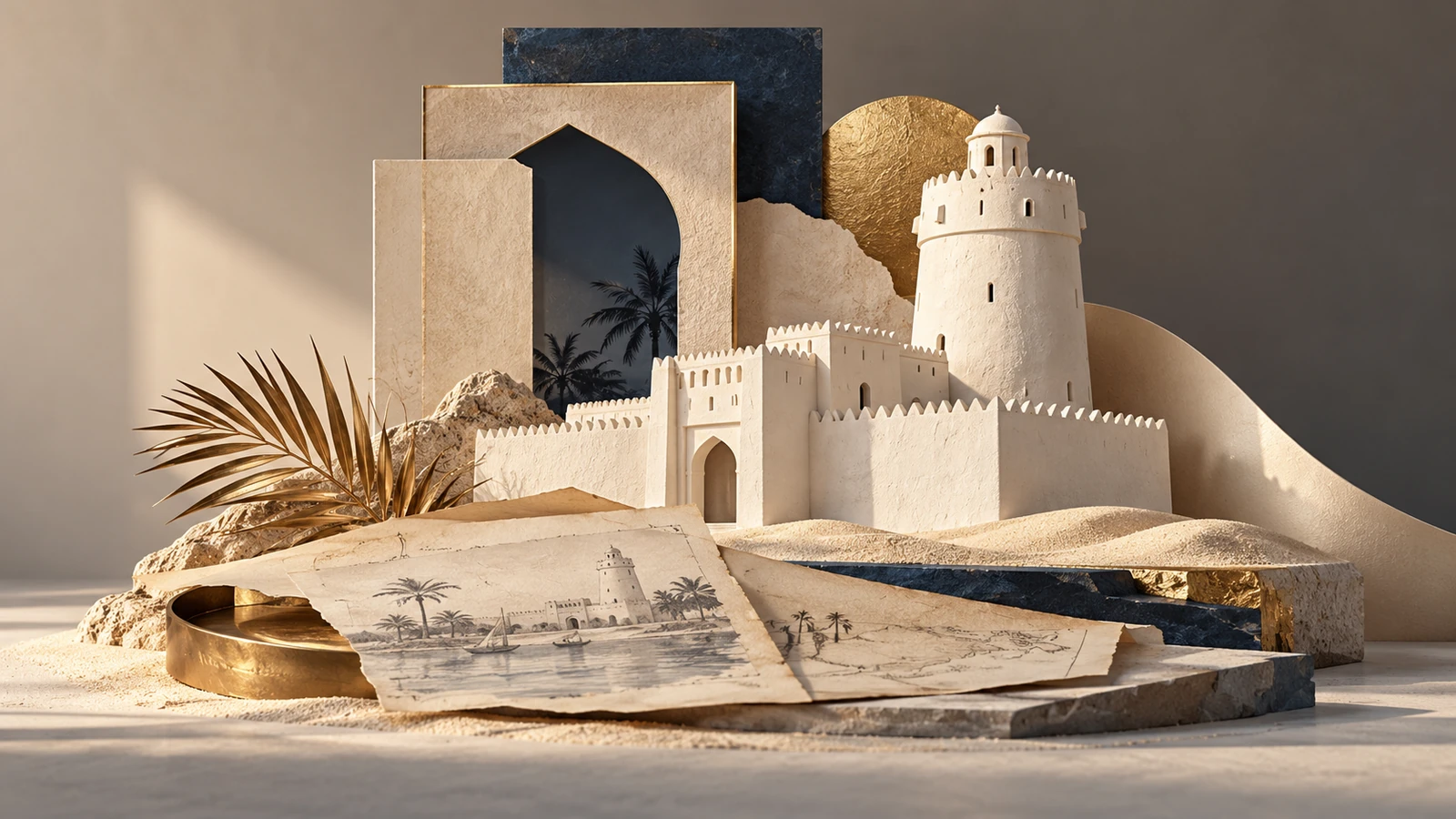
Qasr Al Hosn offers a different starting point for understanding Abu Dhabi from a panoramic photograph of the modern skyline. The useful question here is how a settlement becomes a place of government, exchange and collective memory. A visit becomes richer when the building is treated as evidence rather than merely a backdrop.
This guide connects the site's historical layers with a practical method for looking, reading and asking questions. It does not claim firsthand access or describe a current exhibition that has not been inspected. Historical facts come from the linked official institutions; the suggested route and observation exercises are editorial proposals that visitors can adapt to their own time and interests.
Begin by separating the building's different periods
The official tourism account identifies a watchtower dating to around 1790, the Inner Fort built in 1795 and the Outer Palace added between 1939 and 1945. It describes the site's later opening as a museum in 2018 after extensive conservation. These are different historical moments, not interchangeable dates for one construction event. [1]
Related reference: Saadiyat Cultural District: Plan an Abu Dhabi Museum Visit Around Attention, Not Just Tickets.
Before entering, ask which structure a description refers to. A photograph labelled simply as an old fort can conceal several phases of construction, use and repair. The age of an object displayed inside is also different from the age of the room containing it. Keeping those distinctions visible prevents an attractive visual impression from becoming an inaccurate timeline.
Use a small chronology in your notes: early defensive structure, fort, palace, later institutional uses, conservation and museum. Add detail from the labels encountered on the day rather than attempting to memorise an entire history beforehand.
Look at protection and settlement together
A defensive building raises questions about what needed protection and who depended on that protection. The site's historical account connects the watchtower with coastal access and the community forming on the island. It explains the later development of a defensive enclosure and the fort's roles as government headquarters and family home. [2]
That description invites an economic reading. Ask how people, goods and information might have moved around a coastal settlement. Where would decisions have been made? How did domestic life relate to political authority? These are questions to investigate through evidence, not a licence to invent the routine of an individual resident.
Related reference: Al Ain’s Cultural Landscape: Read the Oases, Archaeology and Water Systems as One Story.
A family can make the exercise concrete by choosing one visible feature and asking what problem it helped solve. An adult might focus on movement through an entrance; a child might notice the view from a wall. Both observations become more useful when checked against an explanation rather than immediately turned into a story.
Use the palace layer to investigate change
The Outer Palace belongs to a much later period than the Inner Fort. Their relationship makes change visible within a single site. Instead of asking whether the monument is old or modern, examine how successive uses required different scales, spaces and forms of organisation.
A productive comparison might ask which spaces appear public, which feel more enclosed and how movement is directed. If a label explains a room's function, record that wording accurately in your own notes. If no evidence is supplied, call the observation a question rather than asserting a historical use.
This approach also avoids a common museum mistake: treating newer construction as less authentic or less valuable. A later layer may contain evidence about a different phase of the same city's development. The task is to understand its period and purpose, not to rank every wall by age.
Related reference: Getting Around Abu Dhabi: Hafilat, Route Planning and the Real Cost of a Daily Commute.
| Site layer | Observation question | Evidence to seek |
|---|---|---|
| Watchtower and fort | What did protection and visibility mean here? | Official chronology and architectural interpretation |
| Palace | How did scale and spatial organisation change? | Room descriptions and period records |
| Council building | How was consultation given a physical setting? | Institutional history and chamber interpretation |
| Conservation | What was retained, repaired or explained? | Museum conservation information |
Connect architecture with consultation
The nearby National Consultative Council building adds a distinct political layer. The Ministry of Culture describes a building constructed around 1968 as a majlis, becoming home to Abu Dhabi's National Consultative Council in 1971 and hosting the Federal National Council in 1972. Its record connects the place with dialogue and the development of government institutions. [3]
A visitor can use that chronology to think about continuity and change in the spaces where public affairs are discussed. The building's physical arrangement and institutional history belong together, but they should not be used to make claims about the content of a particular debate unless a reliable record supports them.
If the building or an interior is not accessible during the visit, the research question still has value. Read the official material, observe what is publicly visible and be explicit about the limits of access. A closed door is a planning fact, not an invitation to describe an unseen room as though it was visited.
Give craft a place in the history
The official House of Artisans account describes demonstrations and learning around Al Sadu weaving, Khoos palm-leaf work and Talli embroidery. It presents those practices as living skills, not simply objects left behind by the past. [4]
Watch process as well as product if a demonstration is available. What material is being prepared? Which actions repeat? What takes concentration? Ask before photographing people or close details of their work and follow the instructions for the particular session. Availability should be checked directly; the existence of a permanent institution does not guarantee that a specific demonstration is running whenever a visitor arrives.
An illuminating comparison is between a finished piece and the work required to make it. The exercise can change how a visitor thinks about value. Price, skill, time and cultural meaning are related but not identical measures. That interpretation should remain grounded in what is explained and observed rather than in invented claims about an artisan's personal story.
Plan a visit with one central question
A hypothetical visitor interested in urban history might centre the day on settlement, power and building change. Another interested in material culture might spend more attention on objects, craft and conservation. A family could choose the question of how people made a place liveable. These are suggested themes, not official tour products.
Check the site's current visit information, ticket categories and programme before departure. The official planning page distinguishes general site access from admission and activities that require separate arrangements. Do not assume that one booking includes every workshop or special event. [5]
Allow a transition between travel and close attention. Arriving with a full schedule, a hungry child and a deadline for the next attraction makes sustained looking difficult. Reserve time for rest and treat optional nearby stops as optional. A shorter visit with one question answered can be more useful than a long route completed without attention.
A practical observation notebook
Use three headings: what I saw, what the source says and what I still want to understand. Under the first, record a feature or object. Under the second, summarise the relevant label or official explanation. Under the third, write a question that remains open. This simple division separates observation from knowledge and speculation.
For example, a visitor might notice a contrast between two building areas, find that they belong to different construction phases and then ask how use changed between those periods. That is an evidence-led line of enquiry. It is stronger than describing every contrast as an intentional symbol without documentary support.
After the visit, select one question for further reading through the official resources. Avoid publishing identifiable visitors or artisans without appropriate permission. If sharing an account, distinguish a personal response from a factual historical claim and identify the sources for the latter.
Questions before choosing the day
Is Qasr Al Hosn just a fort visit?
Its value comes from several connected layers: the defensive structure, palace, institutional history and surrounding cultural activity. The exact areas and programmes available should be confirmed for the visit date.
Must everything be visited in one session?
No. Select a manageable theme and sequence. Nearby institutions can support the same question, but adding stops is useful only if attention and travel time allow it.
Can children learn without reading every label?
Yes. Choose a specific task, such as comparing materials or identifying how a space is entered, then connect the observation with an age-appropriate explanation. The task should encourage curiosity rather than claim a historical answer in advance.
Why does conservation matter to the experience?
A museum is a place where evidence has been selected, preserved and interpreted. Asking how the building reached its present condition helps visitors understand that what they see involves historical material and later stewardship. Qasr Al Hosn becomes more than a photograph when the visitor can explain one of those relationships accurately.
Official sources and editorial method
Sources checked on 1 November 2026. Numbered references support the official facts stated. Planning frameworks and hypothetical scenarios are CYUAE editorial analysis, not individual legal or tax advice. Conceptual imagery does not depict actual documents, properties, trails or museum exhibits.


