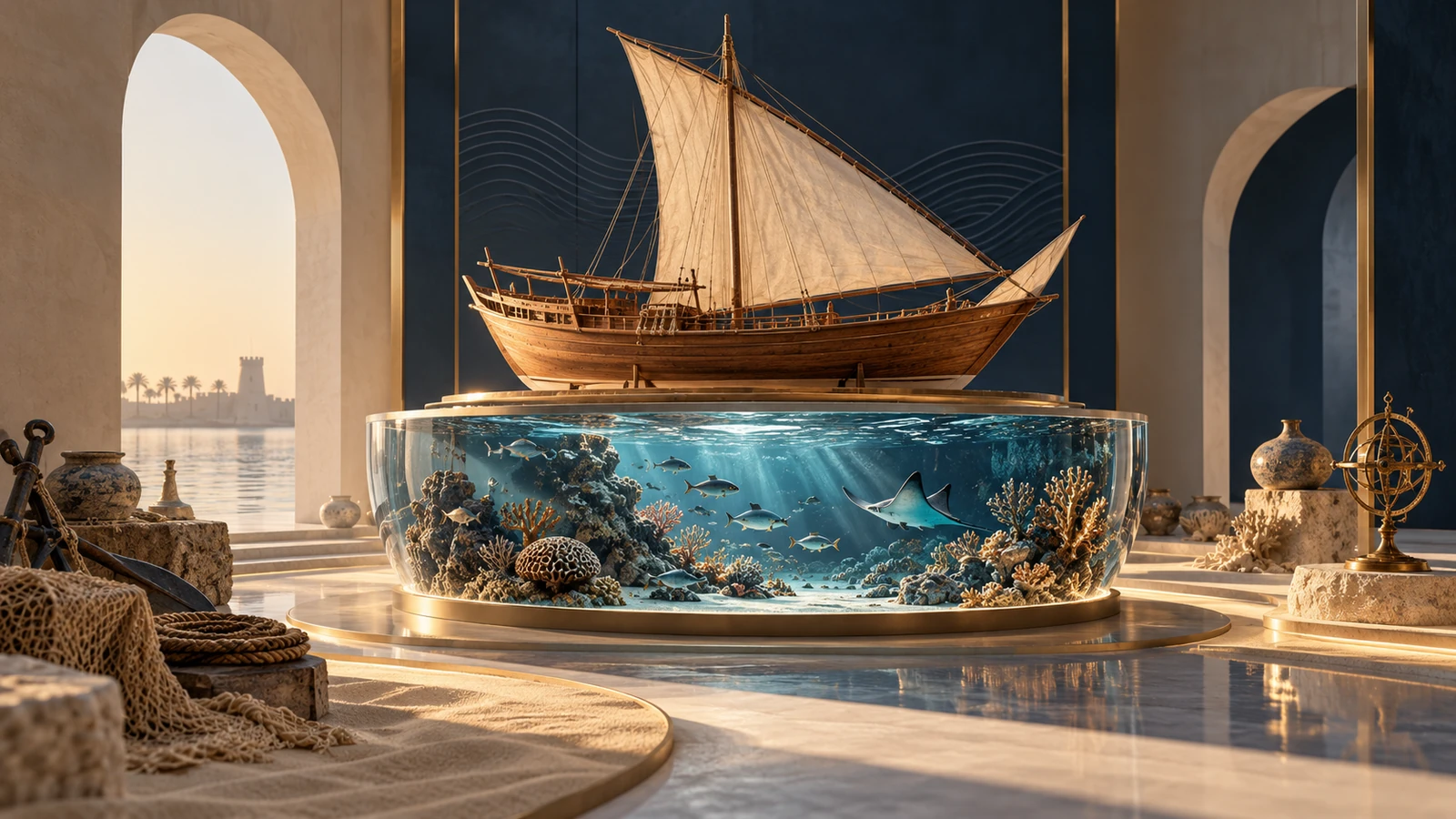
A boat, a pearl and a fish tank can seem like unrelated attractions until the visitor asks what connected them in a coastal economy. Sharjah Maritime Museum and Sharjah Aquarium offer a useful opportunity to investigate that relationship. One introduces human work around the sea; the other encourages attention to marine life and environments.
The strongest combined visit has a question running through it. How did livelihoods depend on knowledge of the water? What skills were required to work at sea? How does looking at a living environment change the way a museum object is understood? This guide proposes a learning route around those questions without treating the two institutions as interchangeable or claiming that every display is available on every day.
Establish what each institution contributes
Sharjah's official tourism account describes Maritime Museum displays dealing with fishing, pearling and trade, including wooden boats and equipment associated with maritime work. Sharjah Museums Authority presents the museum within its history-focused visitor routes. Those accounts establish the broad subject of the institution, not a guarantee that any individual object will remain on display indefinitely. [1][2]
Related reference: Sharjah Museum of Islamic Civilization: A Visitor’s Guide to Reading Objects, Ideas and Scientific History.
The Aquarium's official page places it in Al Khan beside Maritime Museum and describes marine environments including reefs, rocky shores, lagoons and mangroves. It is a setting for learning about living organisms and habitats rather than a substitute for a historical account of coastal work. [3]
Keep those roles distinct. An aquarium observation can prompt a question about habitat, but it does not prove how a particular historical fishing trip was organised. A museum tool can reveal a human practice, but it does not establish the present condition of a wild population.
Check the day directly because official pages differ
A practical complication emerged during the source check on 1 November 2026: the Aquarium page and the authority's general FAQ do not present identical timing information. The FAQ includes a Sunday closure and different Friday information, while the dedicated Aquarium page gives another weekly pattern. [3][4]
Today is a Sunday. Do not choose the more convenient version and describe the Aquarium as confirmed open. Contact the institution or verify the booking response for the specific date before travelling. This guide therefore does not reproduce an opening timetable as settled fact.
Related reference: Souq Al Jubail: Read Sharjah’s Food Market Through Trade, Household Choices and Everyday Culture.
This is a useful general lesson for cultural planning. A source can be official and still require clarification when two pages conflict. Retain the institution's direct confirmation and ask separately whether both venues, a special activity and the relevant ticket are available. Do not infer the museum's status solely from an Aquarium announcement.
Begin with work, materials and the shape of a boat
In the Maritime Museum, select one boat display or model and look before reading. What is visible about shape, load space, rigging or the arrangement for people aboard? Then use the label to establish which observations are relevant to the boat's stated function. Avoid assuming that all wooden craft served the same purpose.
The educational value lies in connecting design with a problem. A vessel must accommodate people, equipment, movement and environmental conditions. A visitor need not know specialist terminology to ask how those demands influenced form. Where the museum supplies a term, record it carefully rather than replacing every craft name with a familiar general label.
For children, a drawing can slow the visit productively. Ask them to sketch one feature and explain what they think it does. Check that interpretation against the display afterwards. The sequence rewards observation while making it normal to revise an initial guess.
Related reference: Khor Kalba Mangroves: Plan an East-Coast Nature Visit Around Observation and Conservation.
Read pearling through skill and organisation
Official visitor information identifies pearling as one of the museum's central subjects. [1] Use that as a starting point for questions about coordinated work: who prepared equipment, what knowledge was needed, how time at sea affected households and how an object acquired value after collection.
Do not romanticise the activity into a story about effortless discovery. Equally, do not assign a specific experience to a named historical person unless the exhibit supports it. The useful habit is to ask what evidence is being offered: equipment, an oral account, a photograph, a reconstruction or a written record.
A pearl can be examined as both a material object and an economic object. Appearance helps explain why people valued it, but the surrounding evidence is needed to understand labour, exchange and social relationships. That is an interpretation framework, not a claim that one display contains the complete history of the industry.
Let the Aquarium change the scale of attention
If opening is confirmed, enter the Aquarium with a narrower task than seeing everything. Choose one habitat grouping or one behaviour to observe. Look for differences in movement, shelter, colour or feeding method, while following the site's directions and avoiding actions intended to disturb animals for a photograph.
The official page describes local marine life and varied habitat settings. [3] Use the interpretation to ask why an organism's surroundings matter. Do not treat an animal encountered in a managed tank as evidence that the same species can be found safely or reliably at a particular public beach.
A hypothetical family might choose the theme of shelter. Each person identifies a place where an animal pauses, then checks what the display explains about the environment. The aim is attentive looking. A guessed behaviour should be recorded as an observation or question, not published as a biological fact.
| Stop | Useful question | A manageable task |
|---|---|---|
| Boat display | How did design support work? | Sketch one feature and verify its role |
| Fishing or diving equipment | What knowledge did the tool require? | Compare object and explanation |
| Trade or pearling display | How did work become exchange value? | Identify the evidence type |
| Habitat display | How does the environment shape behaviour? | Watch quietly, then read the interpretation |
| Final reflection | What connection changed your understanding? | Write one supported conclusion |
Use the joint ticket intelligently
Sharjah Museums Authority confirms the existence of an Aquarium and Maritime Museum joint ticket. [5] That can make a combined visit practical, but it should not dictate the pace or imply that both venues have identical opening arrangements. Check the current price, eligibility, validity conditions and operational status directly before buying.
A ticket is an access product, not a promise that a family will enjoy two uninterrupted sessions. Build a pause between venues and identify where the group can rest. If a child becomes tired or attention drops, adjust the plan rather than treating the purchased combination as an obligation to rush every display.
Where accessibility or sensory conditions matter, ask specific questions in advance about the intended route, lifts, seating, noise and any assistance required. A general statement that a venue welcomes families does not establish suitability for a particular visitor's needs.
Connect the visit to Sharjah without overloading the day
The Al Khan location gives the day a coastal setting, but an outdoor extension should depend on conditions, access and the group's capacity. Avoid assuming that a nearby waterfront automatically provides a safe or accessible route for every party. Check the actual crossing and walking sequence before adding it to a family itinerary.
A different Sharjah museum can provide a useful later comparison. The point is not to collect institutions quickly. Ask whether another visit extends the same question: objects and trade, materials and skill, or the relationship between environment and everyday life.
For a resident household, the return journey is a good time to select one follow-up subject. A school-age child might investigate a boat term. An adult might read about another coastal community. One precise question gives the museum experience a longer life than a large album of unidentified exhibits.
Frequently asked planning questions
Can both venues be treated as confirmed open on Sunday?
Not from the conflicting pages found during this source check. Obtain direct confirmation for the date. Acknowledging the conflict is more useful than publishing a confident timetable that may send a family to a closed entrance.
Which should come first?
For a history-led visit, start with the Maritime Museum and carry a question about livelihoods into the Aquarium. For a group more attentive to living animals, reverse the sequence after confirming access. The suggested order is editorial, not an official requirement.
Is it necessary to attend a feeding demonstration?
No. A demonstration may be a useful addition if the programme confirms it, but quiet observation can support a worthwhile visit. Check the actual session arrangements rather than building the day around an older listing.
What should a visitor remember afterwards?
One supported connection is enough: how a craft's form relates to its use, how equipment represents skilled work, or how a habitat influences what is observed. That is a more durable result than remembering a ticket price while missing the institutions' educational purpose.
Official sources and editorial method
Sources checked on 1 November 2026. Numbered references support the official facts stated. Planning frameworks and hypothetical scenarios are CYUAE editorial analysis, not individual legal or tax advice. Conceptual imagery does not depict actual documents, properties, trails or museum exhibits.