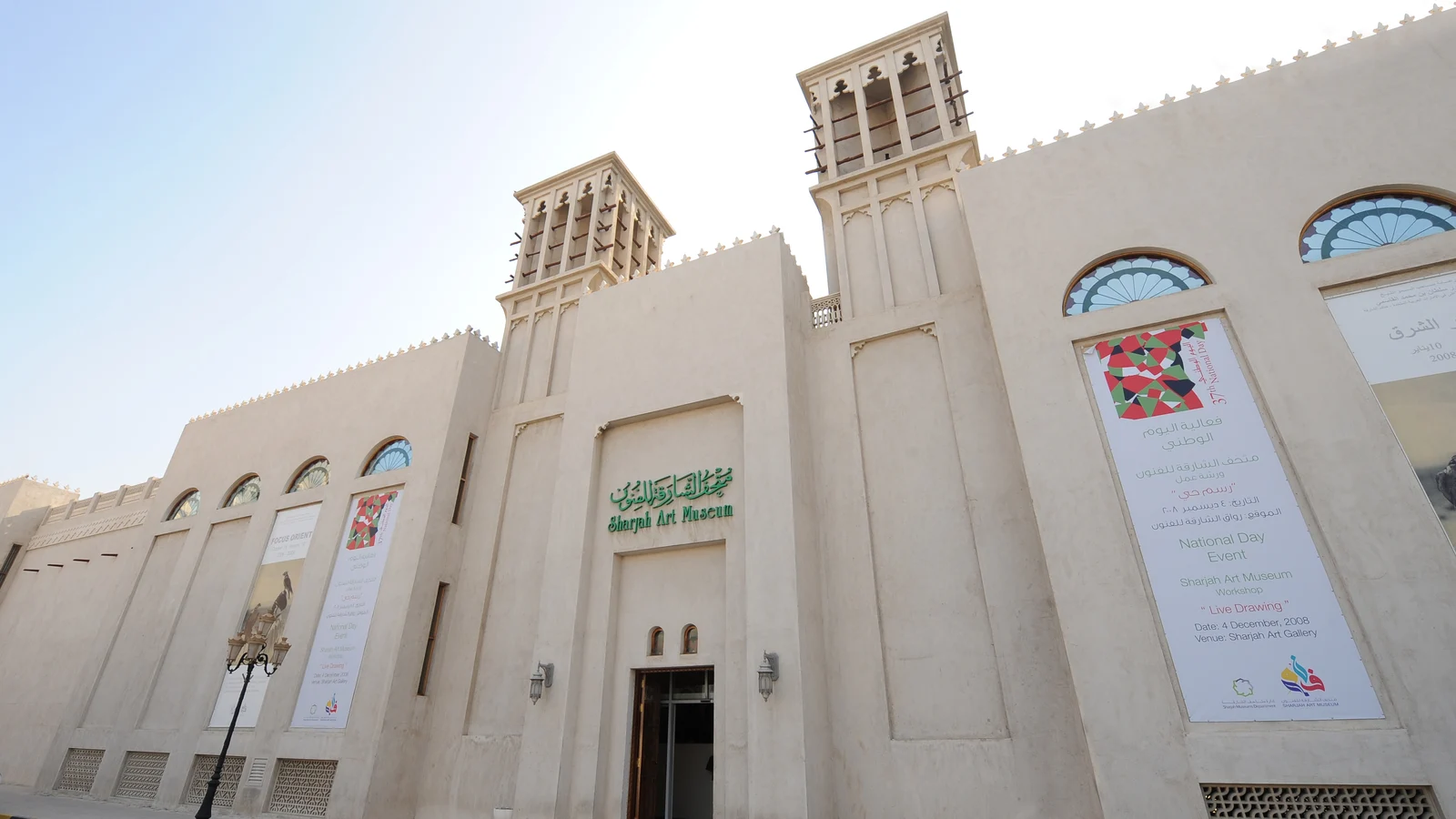
Sharjah Art Museum offers a useful starting point for visitors who want to understand art through sustained attention rather than a rapid sequence of photographs. Its permanent collection includes modern and contemporary Arab painting and sculpture. That gives a visit a different purpose from a general heritage tour: the central task is to look, compare, question and return to works with more informed eyes.[1]
This guide separates the museum's published visitor information from an editorial method for exploring it. The practical recommendations below are planning suggestions, not a claim that a particular exhibition, workshop or gallery arrangement will be available on your chosen day. Sources were checked on 5 November 2026.
Start with the right institution and a clear question
Do not confuse Sharjah Art Museum with Sharjah Art Foundation. Their names can appear in the same travel search, but a booking, exhibition listing or map result for one should not be treated as confirmation for the other. Save the museum's own visitor page and check the address before setting out.
Related reference: Sharjah Art Foundation: How to Plan a Contemporary-Art Visit That Goes Beyond Looking.
The museum is in Al Shuwaihean in the Heart of Sharjah's Arts Area. The official collection page identifies work by artists including Abdulqader Al Rais, Louay Kayali, Faiq Hassan and Ismail Fatah Al-Turk.[1][2] Those names are starting points for research, not a guarantee that every named artist's work will be displayed in the room you enter.
Choose one question before arriving. You might ask how artists use colour to establish emotional distance, how a landscape communicates belonging, or how sculpture changes when viewed from different positions. A question creates a thread through unfamiliar material. Without one, the visit can become a succession of attractive objects whose differences are difficult to remember.
Resolve the opening-time discrepancy before an early visit
At the source check, the museum's dedicated visitor page listed Saturday–Thursday opening at 8am, while the Sharjah Museums Authority museum page listed 9am. Both listed Friday hours of 4pm–8pm. The authority page listed free admission. Holiday and Ramadan arrangements can differ.[2][3]
Treat the conflicting morning start times as a reason to confirm directly, especially if you are travelling across emirates. The museum telephone published by the authority is +971 6 568 8222.[2] A screenshot of an old opening-time panel is weaker evidence than a current response about your actual visit date.
Related reference: Sharjah Museum of Islamic Civilization: A Visitor’s Guide to Reading Objects, Ideas and Scientific History.
| Planning question | Useful action | Why it matters |
|---|---|---|
| Can we arrive early? | Ask which opening time applies that day | Official pages currently differ |
| What is on display? | Ask about current galleries and temporary exhibitions | Collection ownership does not guarantee display |
| Is admission sufficient? | Check whether a desired activity needs separate registration | A gallery visit and a programme place are different things |
| Does someone need assistance? | Describe the whole access requirement in advance | An entrance answer may not cover every part of the visit |
| Can we photograph works? | Ask staff about the particular room and exhibition | Permission should not be inferred from another visitor's behaviour |
Build a visit around depth, not the number of rooms
A practical editorial approach is to allocate three kinds of attention. First, make a short orientation circuit without trying to understand everything. Next, choose a small number of works for close examination. Finally, revisit one work after seeing the surrounding collection. These stages serve different purposes: orientation builds a map, close looking produces detail, and returning tests whether your interpretation has changed.
Avoid committing your entire available time before you know the layout. A visitor interested in one medium may reasonably spend most of the visit in a small area. Someone exploring a broader historical question may move more widely. Neither approach requires claiming that a fast walkthrough is comprehensive.
If travelling with another person, agree on the purpose before entry. One visitor may want quiet contemplation while another expects a social outing. A simple agreement to separate briefly and meet at a chosen point often prevents the pace of the most impatient person becoming everyone's pace.
Use a repeatable method for reading a work
Describe before interpreting
Begin with what is visibly present. Note the arrangement of forms, the relationship between foreground and background, the direction of light, or the way an edge has been handled. These observations are more dependable than an immediate claim about what the artist intended.
Related reference: Saadiyat Cultural District: Plan an Abu Dhabi Museum Visit Around Attention, Not Just Tickets.
Then read the label. Record the title, maker, date and medium where provided. Ask which parts of your initial reading the label supports, complicates or leaves unresolved. This sequence protects the visit from becoming a search for a single official answer.
Separate evidence from association
A painting may remind you of migration, memory or solitude. That association can be personally meaningful without establishing the artist's subject. Use precise language: “This makes me think of displacement” differs from “This depicts a specific displacement.” The second statement needs evidence.
If a work references a historical event, let the exhibition text and further reading carry that claim. Do not infer a national story from a colour, a face or an architectural detail alone. The museum can become an entry into regional history, but visual confidence is not the same as historical knowledge.
Compare two works on one dimension
Choose a single comparison: scale, material, use of negative space, treatment of the body, or the relationship between text and image. Holding one dimension steady makes differences easier to articulate. Comparing everything at once usually produces broad judgments such as “more modern” or “more traditional” that explain little.
Related reference: Seven emirates, more than one way to experience the UAE.
A hypothetical ninety-minute visit
Imagine two adult visitors with roughly ninety minutes available after arrival. This is an illustrative structure, not an official museum tour or a promised minimum visit duration.
They spend the opening portion finding the current galleries, confirming photography rules and choosing a shared theme. Each then selects one work independently. They reunite to explain what they noticed, limiting the first explanation to visible evidence. Only after that do they compare labels and interpretations.
The final part is reserved for returning to a work and writing a short note. A useful note contains one observation, one supported contextual fact and one unresolved question. It is more valuable than a long list of artists copied without a relationship to anything actually examined.
If the visit is interrupted, the plan still works. One well-observed work can produce a meaningful encounter. The objective is not to turn leisure into an examination; it is to give attention enough structure that something remains afterwards.
Make a family or group visit more constructive
For children, ask questions that can be answered by looking: where does your eye go first, which shape repeats, or what changes when you move farther away? Avoid demanding that a child identify the work's “correct meaning.” That makes confidence more important than curiosity.
For a mixed-age group, alternate short independent observation with discussion. Let someone choose a work because it puzzles them. Uncertainty can lead to a better conversation than immediate admiration, provided the group distinguishes disagreement about taste from disagreement about evidence.
Check workshop availability separately rather than promising children an activity seen in an older listing. Likewise, prepare a shorter visit option for anyone who tires easily. An itinerary that depends on everyone tolerating the longest possible route is fragile before the group has even arrived.
Connect the museum with Sharjah without flattening the distinction
The surrounding city provides opportunities to extend the day's questions, but avoid turning every nearby stop into another compulsory attraction. After a concentrated museum visit, a simple break can preserve attention better than adding several unrelated institutions.
A useful follow-up is to compare how different cultural places present evidence. A museum object, a contemporary exhibition and an inhabited commercial district do different kinds of explanatory work. Keep notes under those different headings rather than describing them all as interchangeable expressions of “authentic culture.”
When sharing the visit online, identify the institution and artwork accurately where information is available. Credit an artist rather than attributing the work vaguely to the city. Avoid reposting complete exhibition texts or assuming that permission to take a personal photograph includes every commercial use.
Questions visitors actually need answered
Is this a suitable first art-museum visit?
It can be approached without specialist vocabulary. Begin with a manageable question and close looking. Research becomes more useful when it answers something you have actually noticed.
Is entry free?
The Sharjah Museums Authority page lists free entry at the source check.[2] Confirm separately if your plan involves an event, workshop or other organised activity.
Which morning opening time should I rely on?
The official pages disagree between 8am and 9am for Saturday–Thursday. Confirm directly before planning an early arrival; do not treat this article as resolution of that discrepancy.[2][3]
Does an exhibition mentioned on an old page still run?
An archived exhibition description is evidence that it existed, not that it remains open. Match the exhibition's dates to your visit and ask about present availability.
What should I take away from the visit?
Aim for a clearer observation, a better question and a reliable reference for further reading. Those are more durable outcomes than a claim to have understood an entire artistic tradition in one afternoon.
Official sources and editorial method
Sources checked on 5 November 2026. Numbered references support the official facts stated. Planning frameworks and hypothetical scenarios are CYUAE editorial analysis, not individual legal or tax advice. Photographs are contextual; image credits identify their source and licence. They do not document a particular application or case.